
Paddleboarding in Ayvalık: The Shipwreck Route to Delikli Taş
A half-sunken ship you can paddle up to and touch. A black rock with a hole punched through it. And fifteen minutes of glass-flat water between you and both of them.
The wreck, from a board. No filter, no drone — just eye level.
15 min
Beach to wreck
2 hrs
Full route, with stops
0 m
Swell, all day
What’s in this guide
Why Ayvalık works for beginners
Most people researching paddleboarding in Türkiye end up staring at the southern coast — Fethiye, Kaş, Bodrum. Ayvalık, up in the North Aegean, barely appears in English at all. Which is strange, because geographically it is close to ideal for a beginner.
The town sits inside an archipelago of more than twenty islands. Those islands do the work: they break up the open sea long before it reaches you, so the inner bays behave less like the Aegean and more like a very large, very warm lake. On the day I paddled, there was no swell at all. Not “small waves” — none.
That matters more than most beginners realise. The thing that ruins a first session isn’t distance or fitness — it’s chop, because chop punishes hesitation. Flat water lets you wobble, correct, and keep going. Ayvalık gives you flat water almost by default, which is exactly the environment the complete beginner’s guide to stand up paddleboarding tells you to look for.
The islands are the whole reason this works. You’re paddling in the Aegean — but the Aegean can’t quite reach you.
Getting there
Ayvalık is a two-hour drive from İzmir and about 45 minutes from Edremit Koca Seyit Airport (EDO). It’s known in Türkiye for olive oil, Greek stone houses and the island of Cunda — not for watersports. That gap is precisely why the water is still quiet.
The route, stop by stop
The whole thing runs out of Çamlık, the pine-covered stretch of coast just outside Ayvalık town, in the bay locally known as Paşa Limanı. Roadside parking, a café behind you, and a beach that slopes into the water so gently you barely notice you’ve left it.
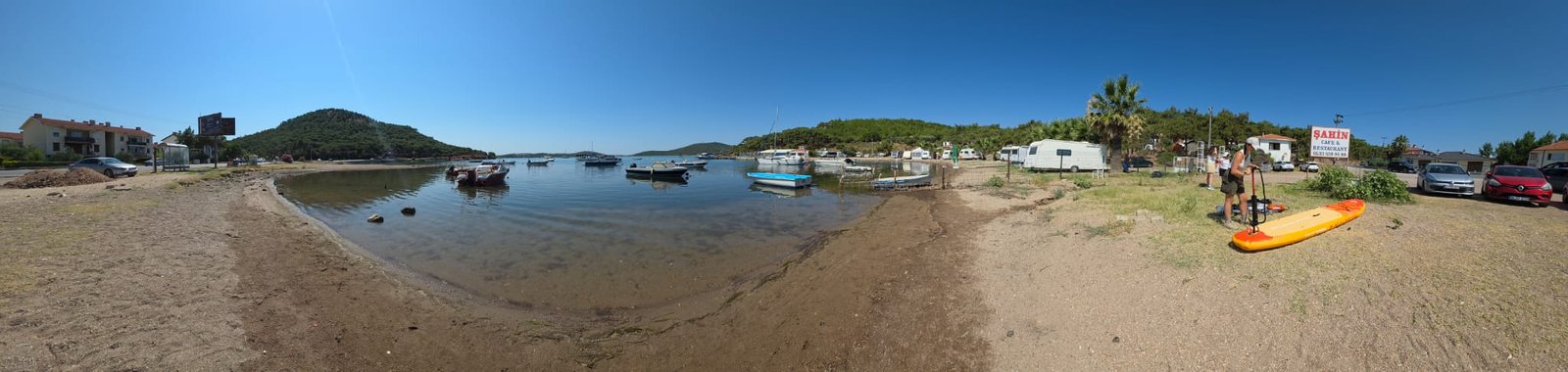
Pumping up at the launch. If you’re doing this on holiday, read the SUP pump guide before you decide what to pack — this is the bit people underestimate.
0:00 · Launch
Çamlık / Paşa Limanı
A flat, sandy entry with almost no gradient — one of the easiest launches I’ve used. A handful of fishing boats and small yachts sit on moorings just offshore, but there’s room to weave between them. Watch for mooring lines sitting just under the surface.
0:05 · Out of the bay
Along the shoreline
Water glassy and shallow enough that you watch the bottom slide past. Patches of seaweed below you; the shore turns rocky as the sand runs out. Nothing technical — just a quiet paddle with pine forest on your shoulder.
0:15 · First landmark
The wreck comes into view
You round a low headland and it’s just… there. Rust-red hull, white wheelhouse tilted at an angle that makes instant sense of the word wreck. Fifteen minutes from the beach, paddled non-stop. Almost nobody does it non-stop.
0:45 · The crossing
Toward Delikli Taş
The stretch between the wreck and Delikli Taş is the only part of the route with real current. Manageable — but it’s the one place you feel the water pushing back. Hug the shore.
1:15 · Turnaround
Beach at Delikli Taş
Pull the boards up onto the pebbles under the rock. Swim, snorkel, eat something. Then paddle back the way you came — same route, same water, completely different light.
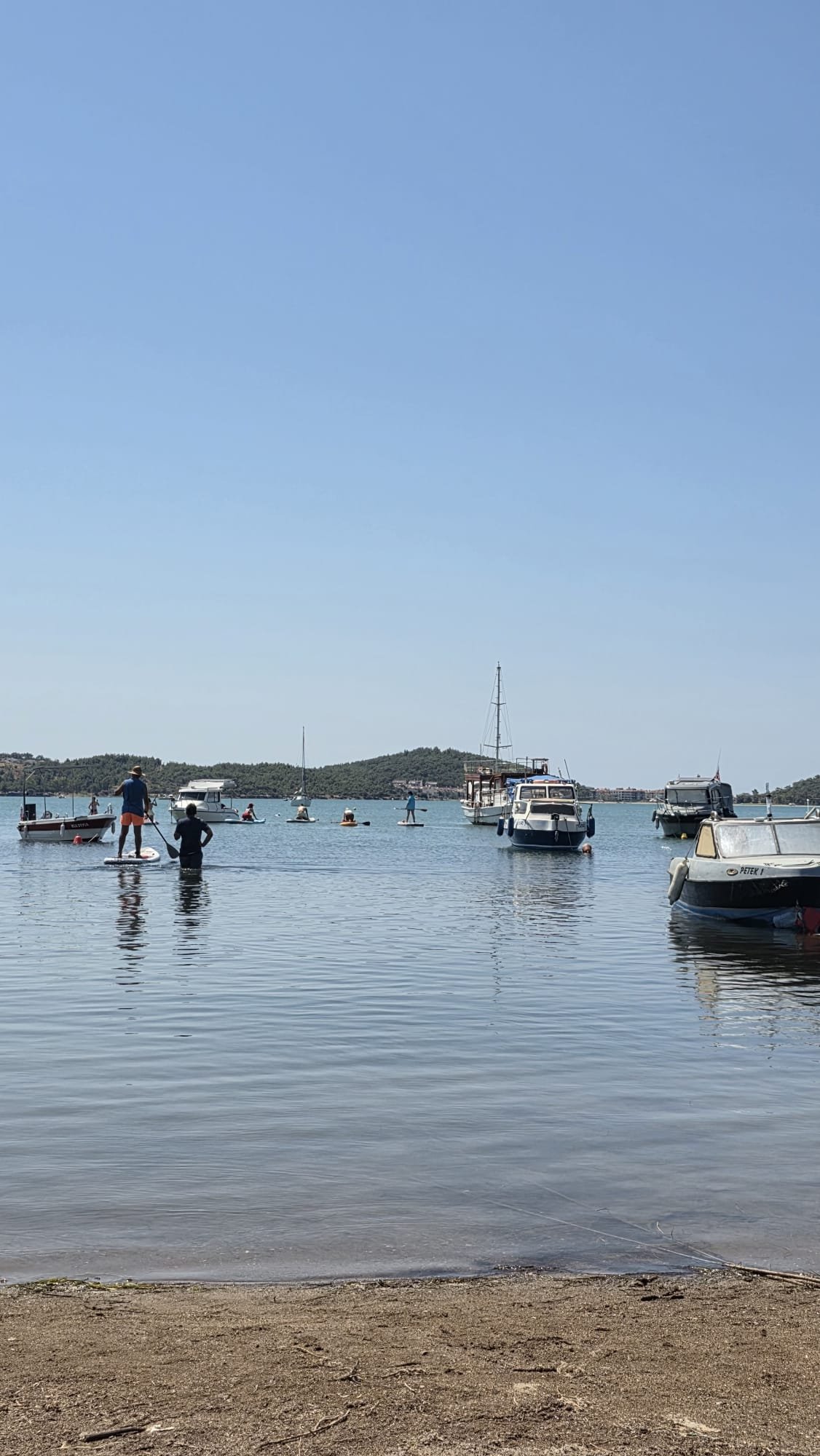
Field note
That’s the sea state, not a filter
This is the water you’re launching into. The boats you see are the only obstacle on the route, and they’re spaced generously enough that a first-timer can steer between them without stress.
Shallow enough to stand in, calm enough to relax — which is also why this bay works well for a family paddle with kids.
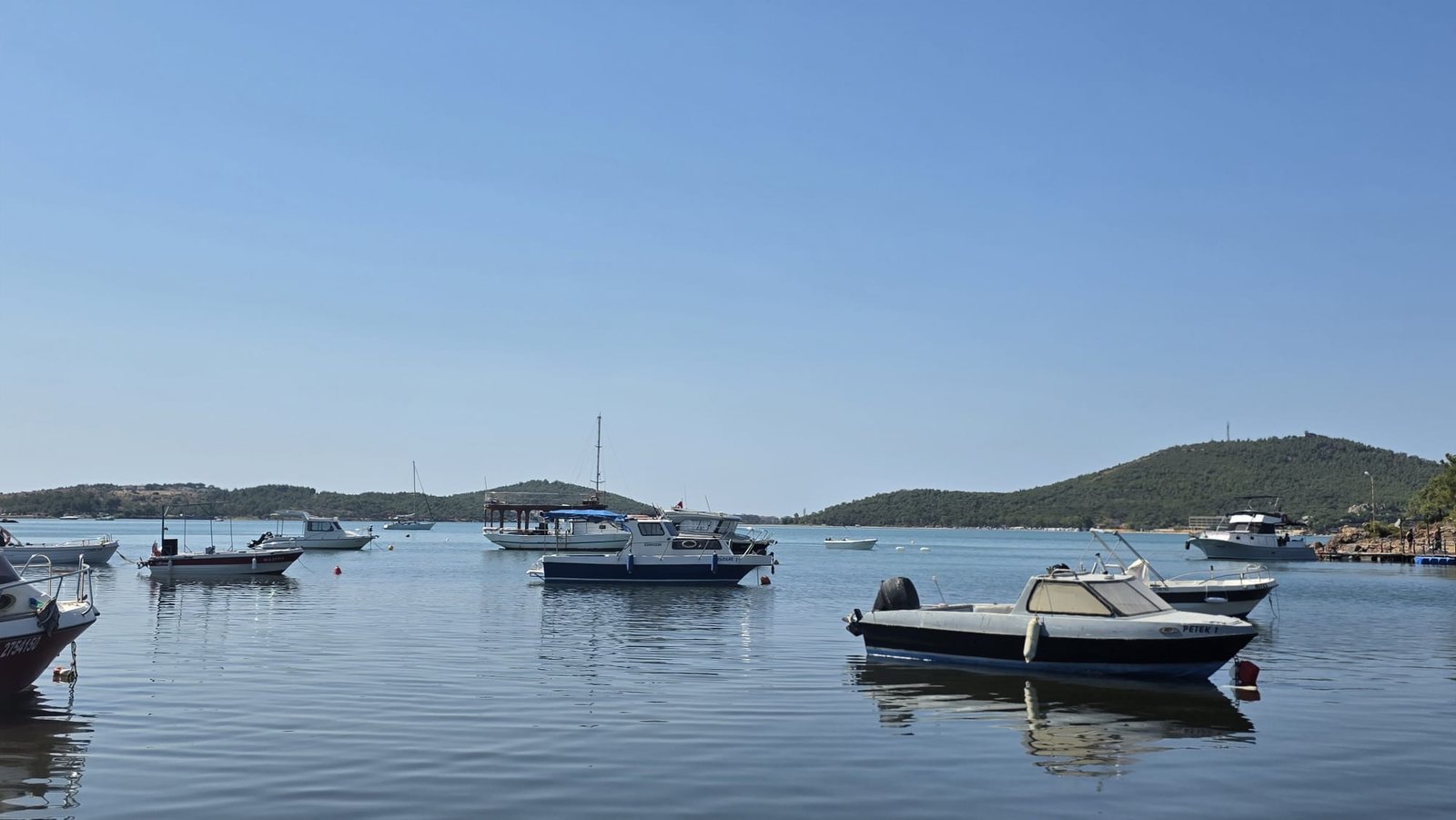
The anchorage you paddle out through. Mirror water, mid-morning.
The shipwreck
Photos undersell it. From a board, sitting low, at eye level with the waterline, the thing is genuinely large — a working vessel, not a decorative prop. It lies half-submerged and heavily listed against the rocks, the stern already given up to the sea, the bridge still standing clear of the water.
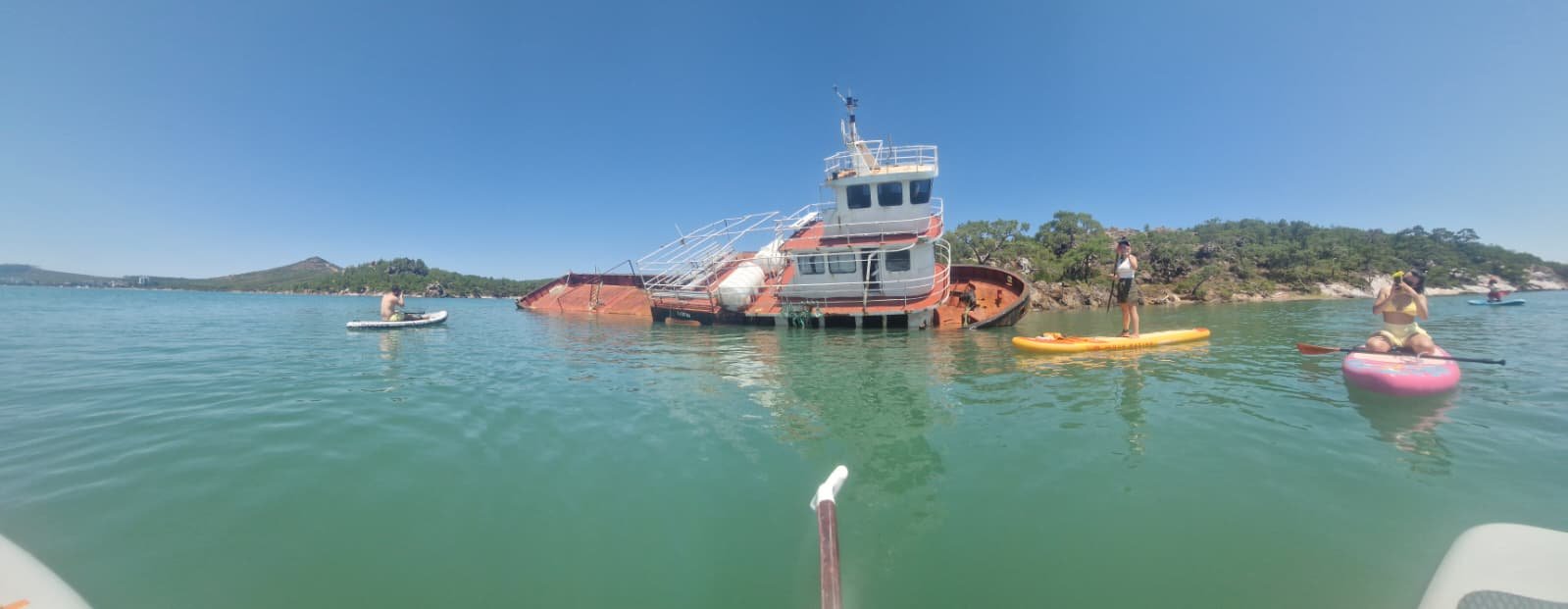
Seven of us reached it in fifteen minutes of easy paddling. There was nobody else there.
You can paddle right up to the hull. You can put a hand on it. And you should be a little careful when you do — it’s a rusting steel wreck, the plating is rough, and the edges are sharp in places. Touch it, don’t climb it, and don’t scrape a bare shin along it.
I tried to find out what it was. I asked around, and I searched afterwards, and I came up with nothing solid — no name, no date, no story. In a coastline where winter storms regularly drive boats onto the rocks, an abandoned hull can simply become part of the landscape without anyone bothering to write it down. Honestly, that’s part of the appeal. It hasn’t been packaged for anyone.
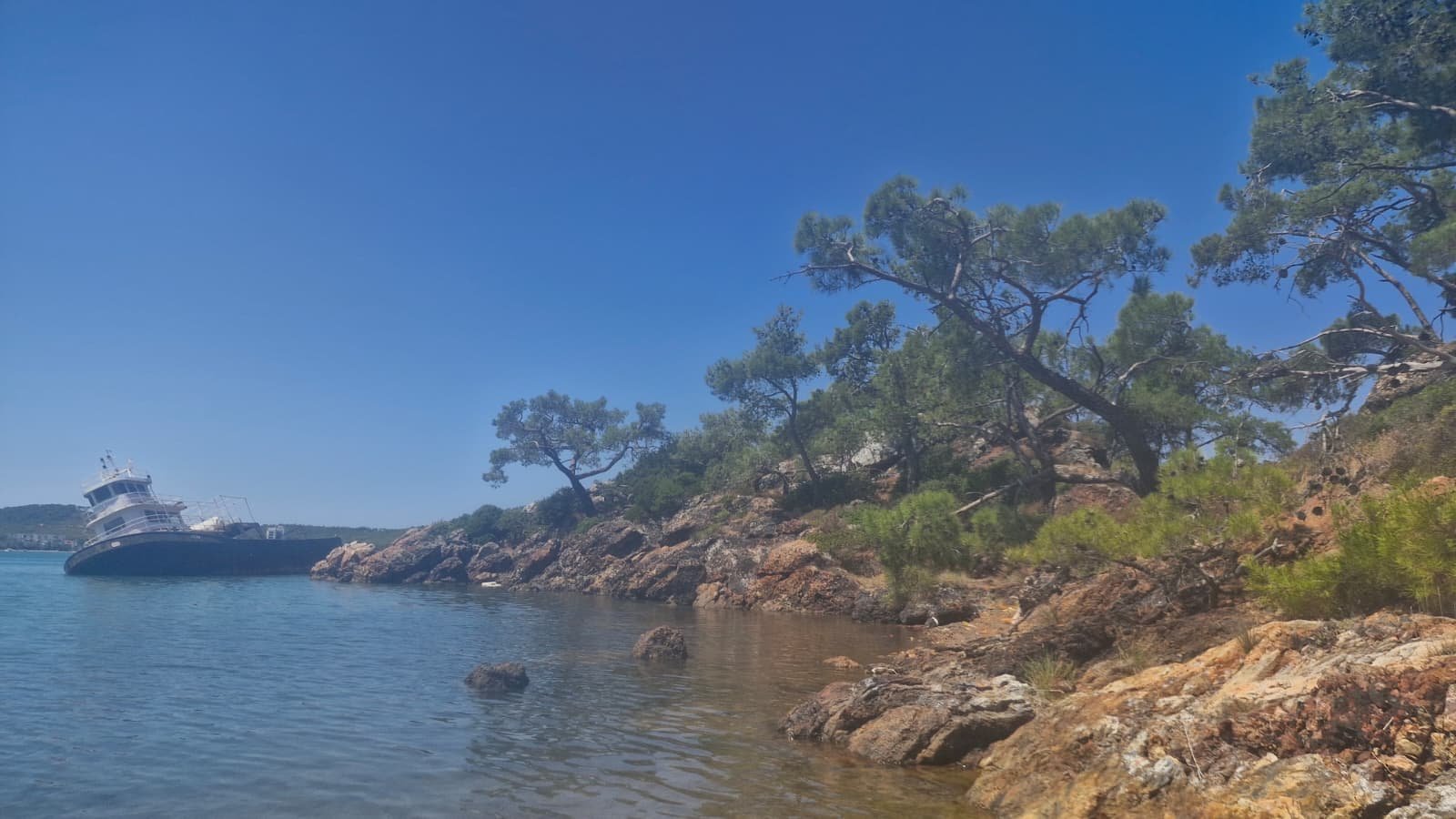
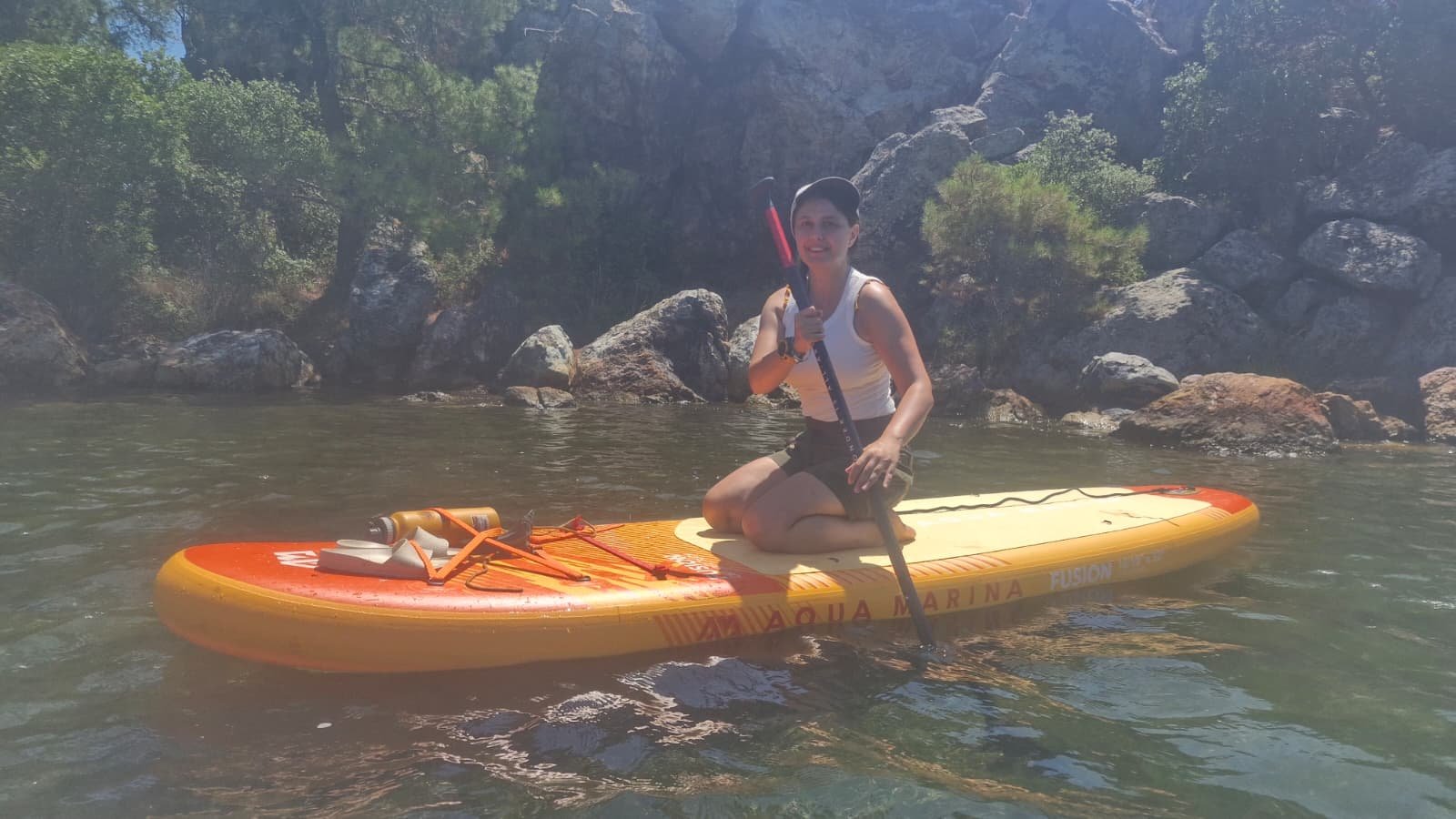
Left: the approach. Right: my board — 10’10” × 33″, bottle and mask clipped to the deck bungee.
Treat it like a wreck, not an attraction
No railings, no signage, no supervision, nobody within earshot. The hull is corroded and there is submerged structure you can’t see from the surface. Stay on your board, keep your leash on, and don’t go inside anything.
This is also the moment the safety kit stops being theoretical. Your board is your lifeboat — the leash is what keeps it attached to you, and a PFD is not optional just because the water looks like a swimming pool.
Delikli Taş, the pierced stone
Delikli Taş translates roughly as “the pierced stone.” Local records describe it as a dark, almost tar-coloured rock that looks like it has erupted straight out of the sea off Çamlık — with a run of rocks nearby that older residents still call Kartal Yuvası, the eagle’s nest.
Up close, it’s exactly that: a jagged black mass rising off a pebble beach, with a natural opening carved through its base. No facilities, no café, no shade beyond what the rock itself throws. Which is what makes it a perfect turnaround — you land, you drag the boards up the pebbles, and you have the place entirely to yourselves.
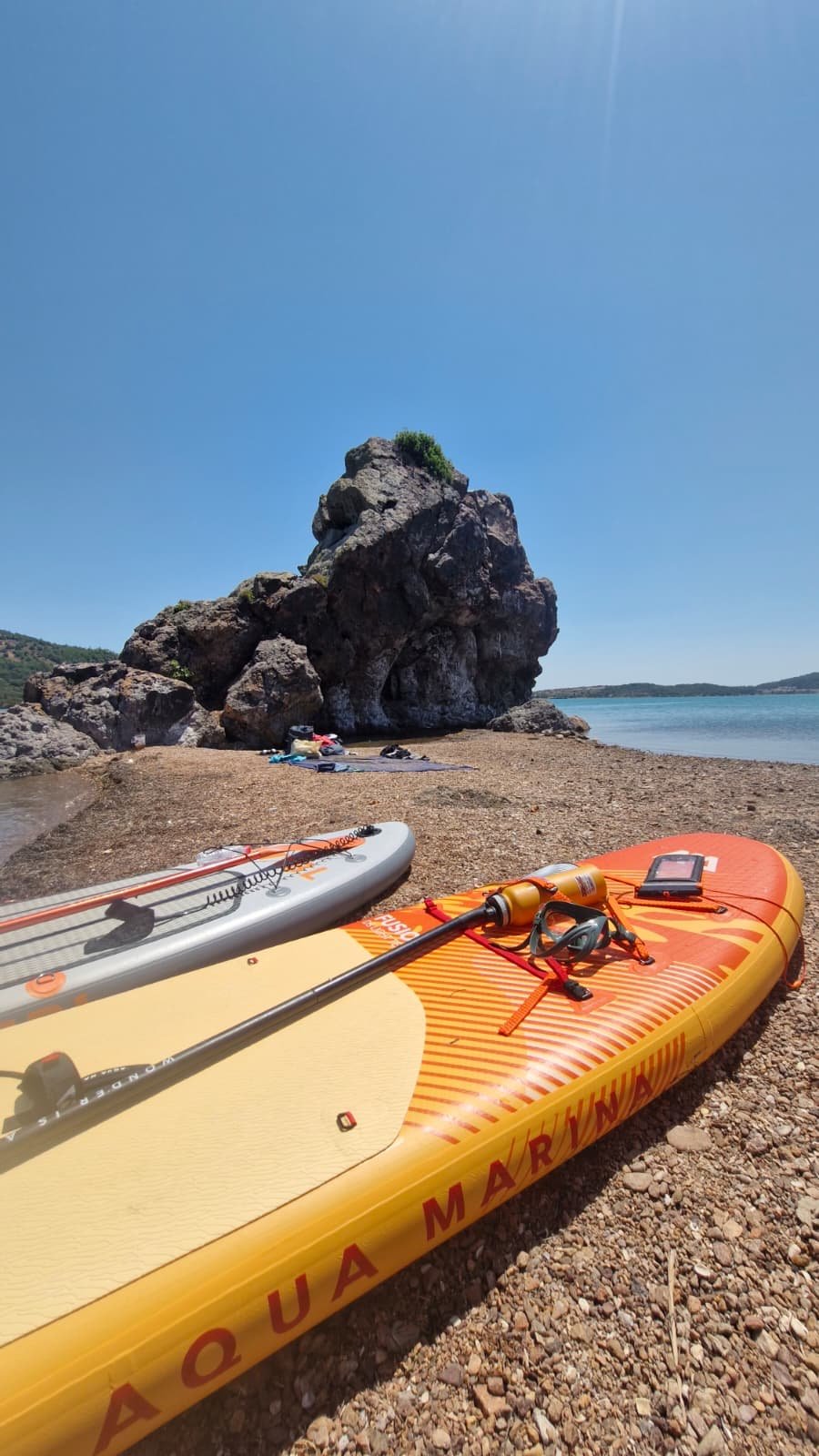
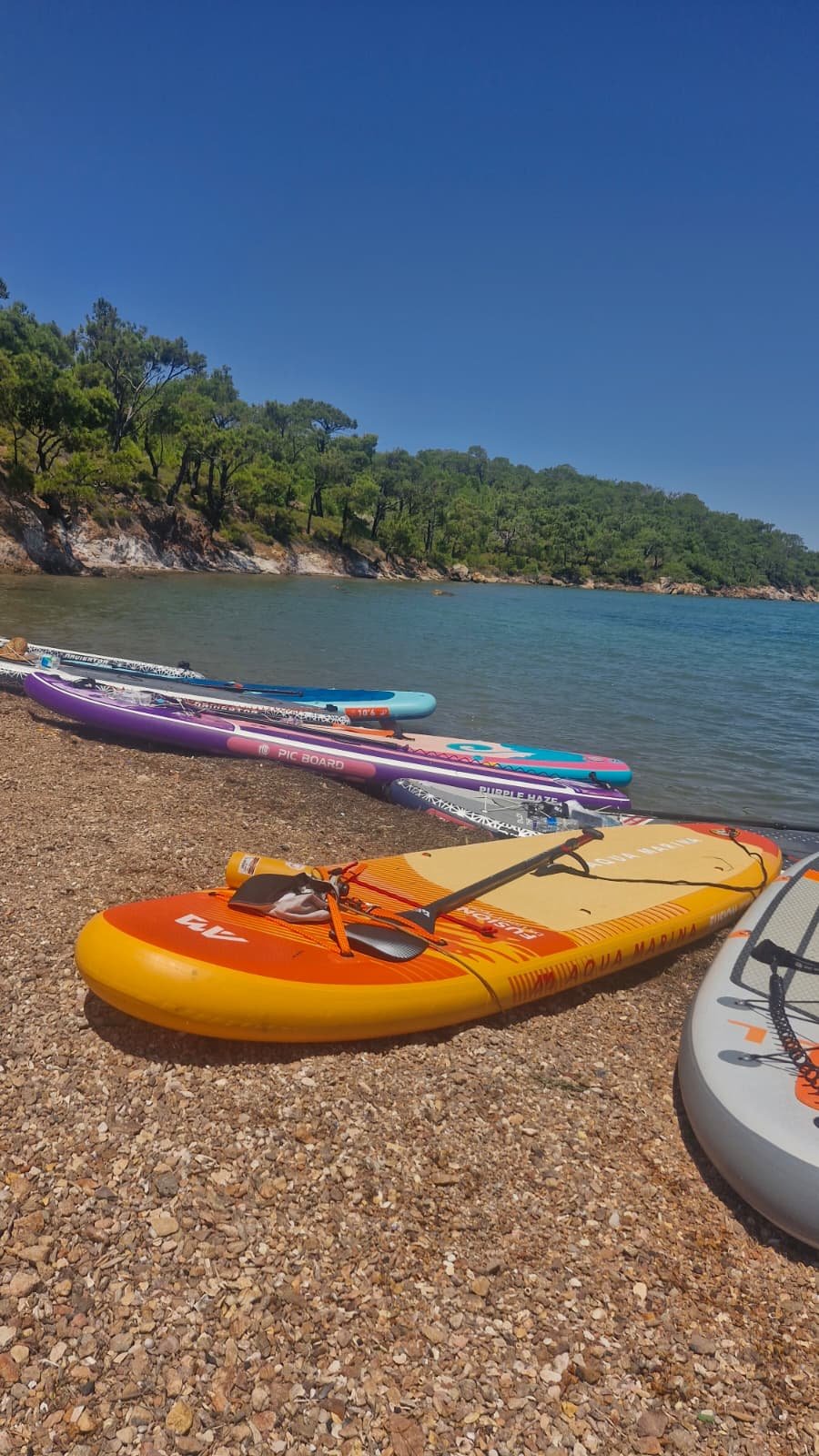
The turnaround. Boards up on the pebbles, mask on, an hour of nothing at all.
Bring a mask. The water off the pebbles is clear and shallow, and there is far more to look at down there than you’d expect. Bring shoes too, or at least flip-flops you don’t mind soaking — the beach is coarse pebble, not sand, and the shoreline through this whole stretch alternates between rock and weed.
If you like this kind of stop
The Turkish Aegean is full of them. Bencik Koyu is the same idea further south — a near-enclosed bay with water so still it feels like a mistake. And on the Mediterranean coast, Soli Pompeiopolis lets you paddle over submerged Roman harbour columns.
Wind, current and timing
Here is the single most useful thing in this guide, so I’ll say it plainly: in the Aegean summer, the wind is a schedule, not a surprise.
The dominant summer wind here is the meltem — known internationally as the etesian, or meltemi. It blows from the north across the Aegean from roughly mid-May to mid-September, and it follows a daily rhythm you can almost set a watch to. Dawn is glass. A light breeze fills in through the late morning. By early afternoon it is properly blowing, it peaks through mid-afternoon, and it eases again as the land cools toward evening.
I paddled the 11:00 slot. That is exactly the point on the curve where the breeze starts to build — and I felt it. It was never dangerous, and Ayvalık’s islands take most of the sting out of it, but it was there. The people who launched at 07:00 that morning paddled on a mirror.
The Ayvalık wind rule
Paddle before 10:00, or after 17:00. Those two windows give you the flattest water and the best light. Between roughly 12:00 and 16:00 you’re paddling into the strongest part of the day’s breeze — and it’s the return leg that hurts, not the outbound one.
Check a marine forecast, not a general weather app. Look at gusts, not just average wind speed. A waterproof watch is more useful here than it sounds — knowing the time on the water is knowing how much breeze is coming.
The Ayvalık paddling day
A typical summer day on the North Aegean, hour by hour. This is a pattern, not a forecast — but it repeats.
The current between the wreck and Delikli Taş
There’s a mild current in the stretch between the two landmarks. I was told locally that it’s weakest in the morning and again later in the afternoon — which happens to line up with precisely the same windows the wind gives you. Two reasons to go early, one answer.
What I packed (and the one item that surprised me)
Short route, warm water, sheltered bay — so the list is genuinely short. But two of these items earned their place in a way I didn’t expect.
My actual kit for this route
- 1 litre of water. For a two-hour session under a Turkish July sun, that’s the minimum — not the comfortable amount. I’d take more next time.
- A snorkel mask. The water at both stops is clear and shallow. Without a mask you’re only seeing half the route.
- Flip-flops. The Delikli Taş beach is coarse pebble and the shoreline is rocky and weedy in patches. Bare feet are a bad plan.
- A 150 cm utility line. This is the surprise. I recently added a short rope to my board and now I use it constantly — tie off to a rock with a bowline while you swim, secure the board at a landing, tether it to someone else’s on a rest stop. It costs almost nothing and it changes how relaxed you are the second you step off the board.
- Two small carabiners. Mask and bottle clipped to the deck bungee. Nothing gets lost, nothing slides off when the board tips.
- Leash and PFD. Non-negotiable, calm water or not.
The thing nobody tells you
A rocky landing is where gear disappears
Every loose item on your deck becomes a liability the moment you drag the board onto pebbles. Phone, keys, wallet, sunscreen — clip it, bag it, or lose it.
This is the one place I’d spend money before anything else: a proper dry bag lashed to the bungee, and nothing floating free.
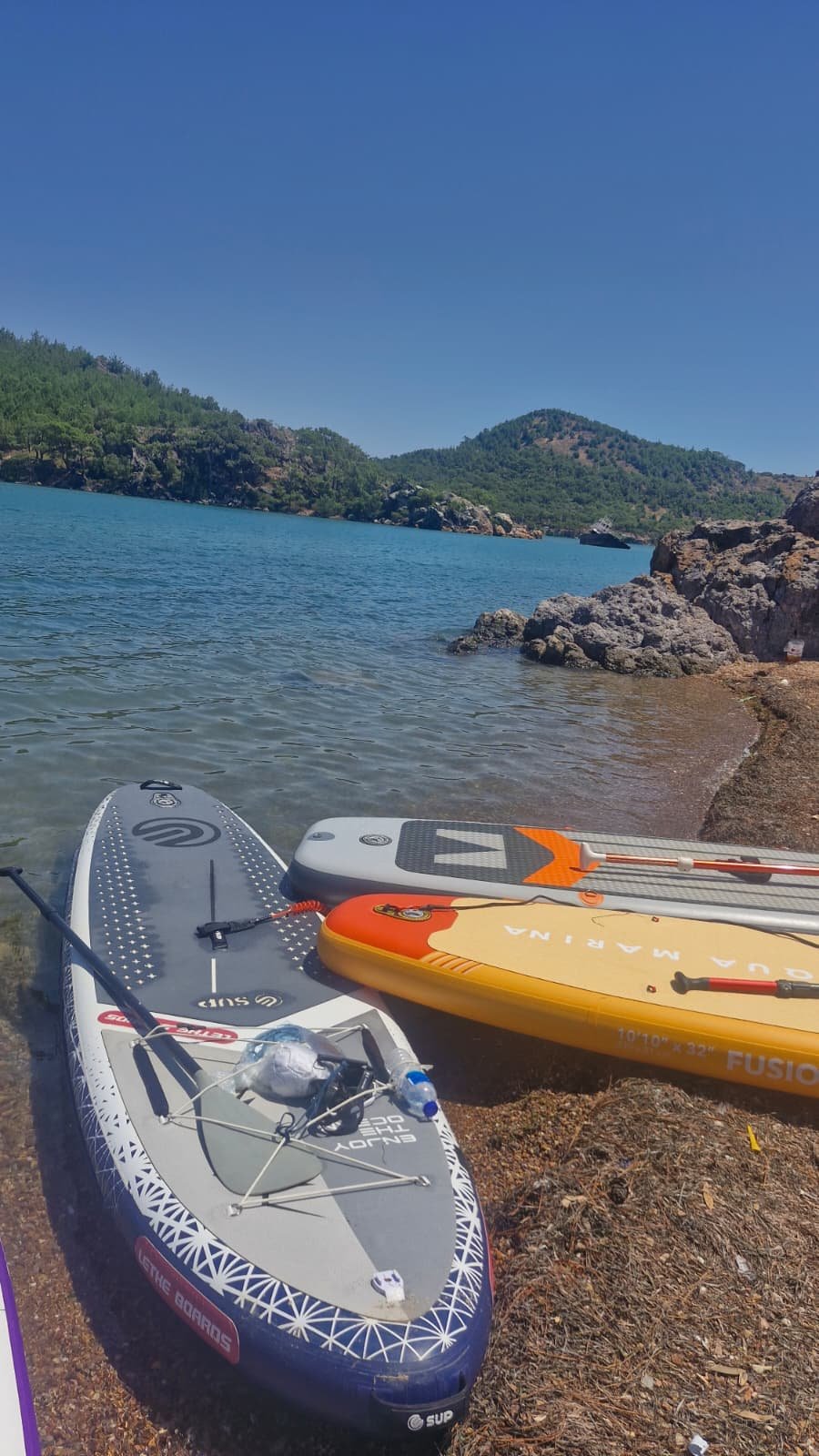
Gear guides that pair with this route
- Best SUP boards for beginners — width, volume and PSI, and why width wins
- Best SUP life jackets & safety gear — PFDs, leashes, and the case for both
- Best SUP paddles for beginners — sizing, weight, and when carbon is worth it
- Best dry bags for SUP — the cheapest upgrade on this list
The board I paddled was a 10’10” × 33″ inflatable. That width is the reason a complete beginner can stand on it within a few minutes — a wider board is a more forgiving board, and on a route like this you want forgiving far more than you want fast. It’s also stable enough for the kind of flat-water session you’d want on a yoga-oriented board, if that’s where you’re heading.
Group vs. bringing your own board
I went out with a local group of about seven people. The organisers supplied boards and gear to anyone who didn’t have their own — the easy option if you’re flying in. But if you’re already travelling with an inflatable, bringing it is meaningfully cheaper: you’re only paying for the guiding, not the kit.
| Option | Best for | Trade-off |
|---|---|---|
| Guided group, their gear | First-timers, solo travellers, anyone arriving empty-handed | Fixed departure times — you may not get the ideal wind window |
| Guided group, own board | Travellers already carrying an inflatable | Noticeably cheaper, but you’re moving a board through an airport |
| Self-guided | Confident paddlers who’ve read the wind section above | No support if the breeze builds — you own that call |
Choosing your slot
Local operators around Ayvalık typically run several sessions a day, from about 06:00 through to 20:00, with a short technique and safety briefing before you launch. If you’re booking one, ask specifically for an early-morning or evening slot. The midday sessions exist because they sell — not because the water is better.
What I’d do differently
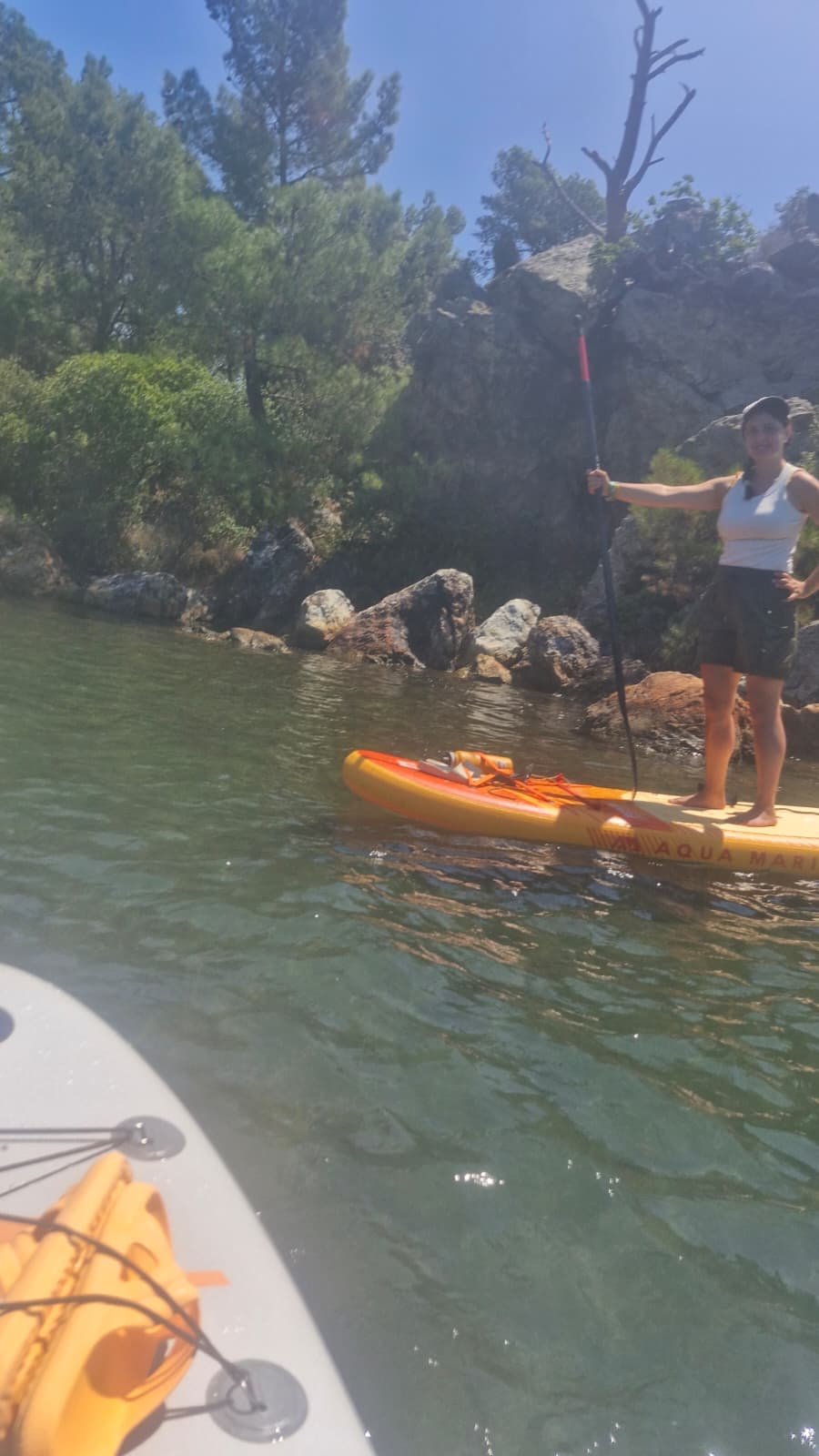
The whole pitch
Flat water, no swell, and nobody else on it
That’s the entire argument for Ayvalık. Not the wreck, not the rock — the fact that a beginner can stand up, stay up, and reach something genuinely worth reaching, without ever being frightened by the sea.
Go early. Take the mask. Have it to yourself.
Frequently asked questions
Can a complete beginner paddle to the Ayvalık shipwreck?
Yes. The water is flat and sheltered, the launch is a shallow sandy entry, and the wreck is roughly fifteen minutes of easy paddling from the beach. Most beginners on a wide inflatable are standing confidently within the first few minutes. The one variable that changes the difficulty is wind — go early and it’s an easy paddle; go at 14:00 in August and it isn’t.
How long does the whole route take?
About two hours with stops, swimming and photographs. Paddled non-stop it’s roughly fifteen minutes out and fifteen back — but nobody does it non-stop, and you shouldn’t.
Can you actually touch the shipwreck?
You can paddle right up to the hull and put a hand on it. It’s a rusting steel wreck, though — the surfaces are rough and the edges are sharp in places. Touch it, don’t climb it, and don’t try to enter any part of the structure.
What is the best time of day to paddleboard in Ayvalık?
Before 10:00 in the morning, or after 17:00. The Aegean summer wind (meltem) builds through the late morning, peaks in the middle of the afternoon and drops again toward evening. Early morning gives you the flattest water of the day and the best light.
Is there a current on the route?
There’s a mild current in the stretch between the wreck and Delikli Taş. It’s manageable but noticeable. Locally it’s said to be weakest in the morning and later in the afternoon — the same windows that give you the least wind.
Do I need to bring my own board?
No. Local groups and operators supply boards, paddles and buoyancy aids for people who arrive without gear. If you already own an inflatable, bringing it usually works out cheaper because you’re only paying for the guiding.
Where exactly is the launch point?
Çamlık, in the bay known as Paşa Limanı, just outside Ayvalık town in Balıkesir province. It’s a shallow, flat, sandy entry with a small anchorage offshore. Parking is roadside and informal, and there’s a café directly behind the beach.
Is it suitable for children?
The bay itself is about as forgiving as open water gets — shallow, flat and enclosed. The full route to the wreck is a stretch for young children, mainly because of the crossing current and the lack of shade, but the launch bay is a genuinely good place to learn. See our family paddleboarding guide for how to structure it.
More Turkish coast SUP routes →
Disclosure: mediterransup.com is a participant in the Amazon EU Associates Programme. Some links in this article are affiliate links, which means we may earn a small commission if you buy through them — at no extra cost to you. We only recommend gear we would use ourselves. This route was paddled first-hand in July 2026; conditions on the water change, and you are responsible for your own safety assessment on the day.