
Most beginner paddlers spend weeks agonising over their board choice — comparing volumes, widths, PSI ratings — and then grab the cheapest paddle they can find as an afterthought.
That’s backwards. Your board floats you. Your paddle moves you. A poor paddle doesn’t just slow you down; it tires your arms in the first twenty minutes, ruins your technique before it’s even formed, and — if you’re unlucky — strains your shoulders in ways that keep you off the water for days.
After spending considerable time on the water testing SUP gear across the Mediterranean coast — from the flat, sheltered bays around Selimiye to the choppier stretches near Bodrum — I can tell you this with confidence: the right paddle makes a noticeable difference on your first session. And the wrong one makes an uncomfortable one.
Here’s what actually matters when choosing your first SUP paddle, followed by the specific recommendations worth your money in 2026.
What Makes a SUP Paddle “Right” for Beginners?
Before getting into specific models, it’s worth understanding the four variables that actually affect your experience on the water. Ignore blade aesthetics, ignore brand logos — these are the numbers that matter.
1. Material: Where Your Budget Goes
SUP paddles come in three main materials, and the differences are real, not marketing.
| Material | Weight | Feel | Price Range | Verdict |
|---|---|---|---|---|
| Aluminium | Heavy (≈ 1,000g+) | Stiff, tiring | £30–60 | Fine for casual/occasional use |
| Fibreglass | Medium (≈ 700–850g) | Balanced, responsive | £80–160 | Best value for beginners |
| Carbon fibre | Light (≈ 500–650g) | Snappy, efficient | £150–300 | Worth it if budget allows |
Aluminium paddles are fine for a one-off rental backup or occasional use. For anyone buying their first paddle to use more than a handful of times per season, they’re a false economy. The extra weight transfers directly to your arms and shoulders — you’ll feel it by the end of a 90-minute session.
Fibreglass is the sweet spot for most beginners. Carbon is worth considering if your budget stretches to it, particularly if you’re already an active person who’ll be on the water regularly. The weight difference between fibreglass and carbon is roughly the weight of a full water bottle — academic in flat water, significant over a two-hour paddle.
2. Adjustability: Why Fixed-Length Paddles Are Almost Never Right
A SUP paddle should be 6 to 10 inches taller than you for general flatwater paddling — closer to 10 inches for touring and longer distances, closer to 6 inches for surf or performance work.
For beginners, an adjustable paddle is almost always the right call, for two reasons:
First, you almost certainly don’t know your ideal length yet. Getting on the water and fine-tuning your paddle height over your first few sessions is part of finding your stance and stroke. A fixed-length paddle locks you into someone else’s best guess.
Second, adjustable paddles collapse for transport — useful if you’re travelling with your board or sharing with a partner of a different height.
The trade-off is a small amount of flex and potential rattle at the adjustment collar. Decent mid-range adjustables handle this well. Cheap ones don’t.
3. Blade Shape and Size: Smaller Than You Think
First-time buyers consistently choose blades that are too large. More blade area feels intuitive — more power per stroke, right? In practice, a large blade catches too much water, disrupts your balance, and exhausts your arms long before a well-fitted smaller blade would.
For beginners, look for a blade surface area in the 85–100 cm² range. That’s considered a medium blade, and it’s the range that rewards consistent technique without punishing early inefficiencies.
Blade offset (the angle between blade face and shaft) typically runs 5–12 degrees. Higher offset reduces wrist strain on the forward stroke — marginally but noticeably over a full session. Most beginner-oriented paddles build in 7–10 degrees, which is fine.
4. Shaft Flex: The Variable Nobody Mentions
Carbon and fibreglass paddles are marketed on their “flex profile” — the amount of give in the shaft during the power phase of a stroke. More flex means more shock absorption, which matters for joints. Less flex means more direct power transfer, which matters for speed and performance.
For beginners, medium flex is the default. You’re not optimising for racing efficiency; you’re building technique. Excessive rigidity punishes every minor error in stroke angle — a problem you don’t need in your first season.
The Recommendations
Best Budget Option: Abahub SUP Paddle — 3-Piece Adjustable Aluminium
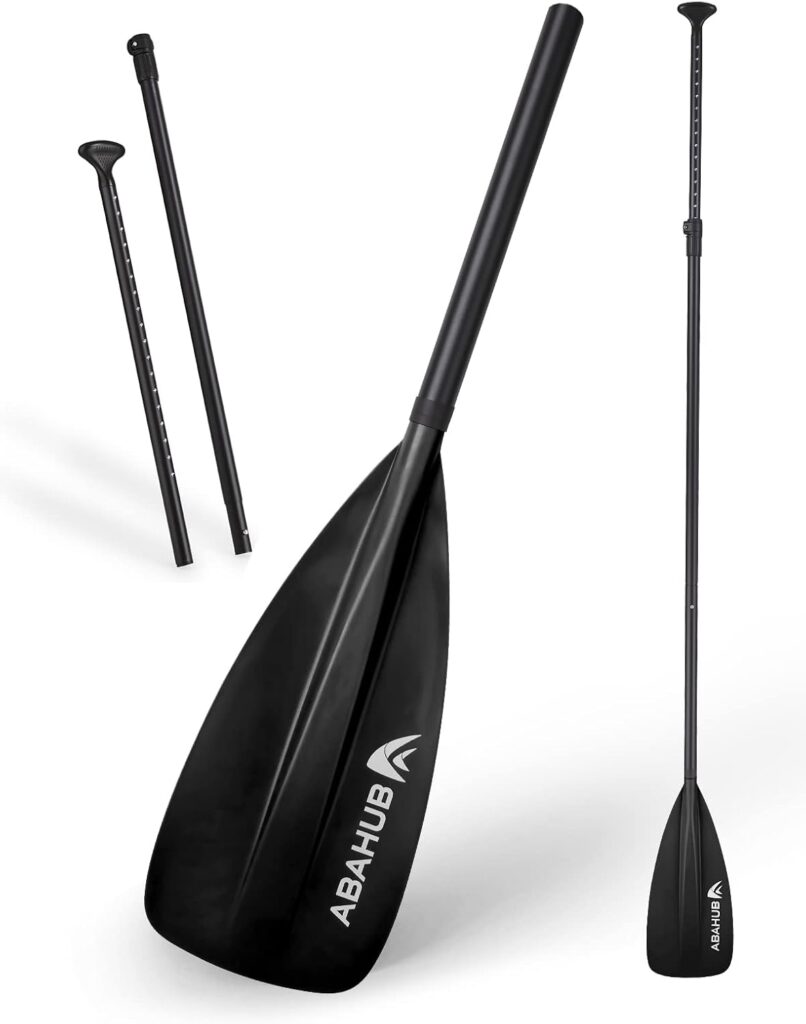
Material: Aluminium shaft, nylon blade | Sizes: Adjustable 68″–84″
The Abahub aluminium paddle is the low-risk way into the sport. It isn’t exciting, and it doesn’t need to be: it’s simple, adjustable, and cheap enough that you won’t mind learning on it.
The aluminium shaft is heavier than fibreglass or carbon alternatives, but the 68″–84″ adjustment range fits most adults comfortably, and the nylon blade holds up well to regular use. Multiple colour options are a minor but genuine plus if you’re sharing the paddle with a partner.
The honest caveat: You will notice the extra weight by the end of a longer session. If you enjoy the sport and paddle more than twice a month, you’ll want to upgrade within a season. Think of this as a “try before you commit” paddle rather than a long-term investment.
Best for: Curious beginners who want to get on the water without spending £100+ before they’re certain they’ll stick with it. Also solid as a second paddle for guests.
Best Mid-Range Upgrade: Trail SUP Paddle — Adjustable Fibreglass
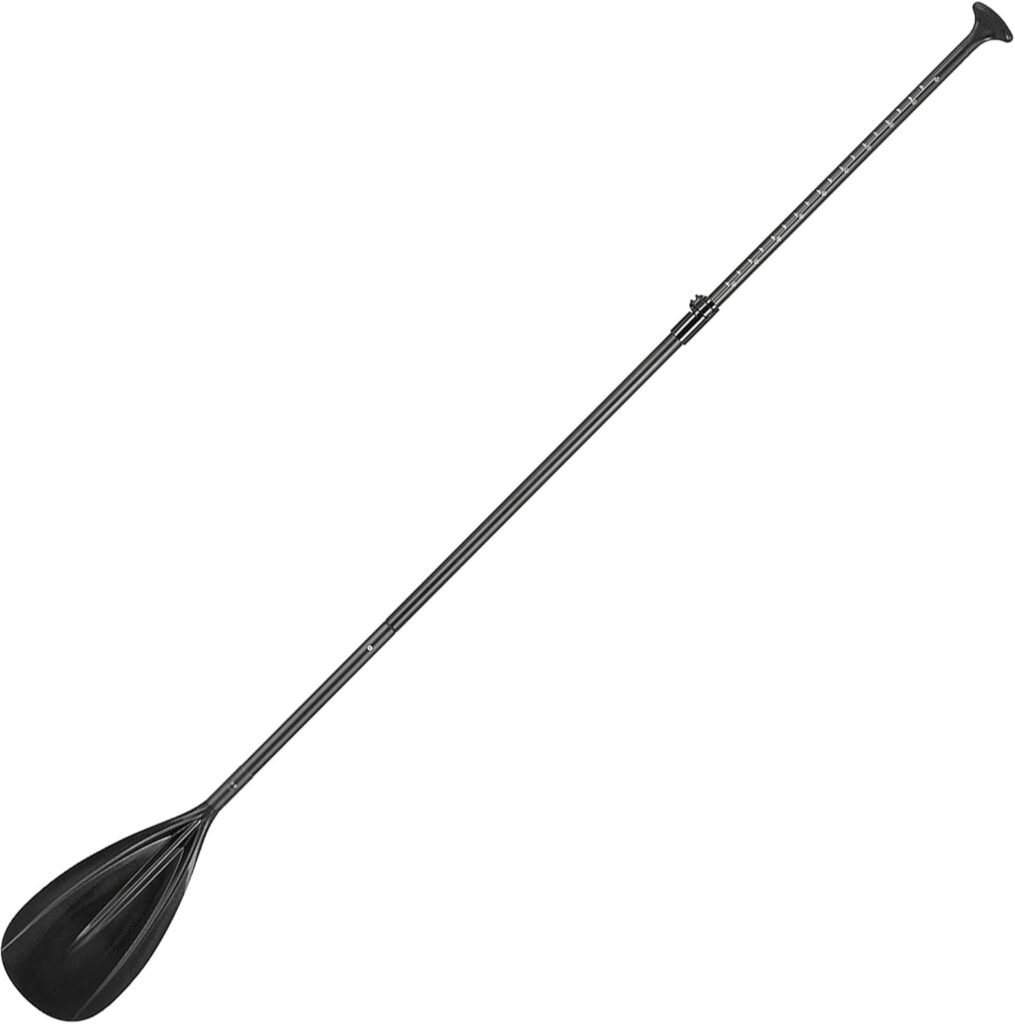
Material: Fibreglass shaft | Sizes: Adjustable 1.67m–2.17m (66″–85″) | Floating
This is the paddle that sits in the sweet spot most beginners eventually land on — light enough to make a real difference over an hour on the water, without the full carbon price tag. The fibreglass shaft brings weight down noticeably compared to aluminium, and the 66″–85″ adjustment range comfortably covers the full spectrum of adult paddler heights.
The floating design is worth calling out specifically: if you lose your grip mid-session — and at some point, every beginner does — the paddle stays at the surface rather than sinking. A small detail that feels very significant when it happens.
Trail is a newer listing on Amazon, but the fibreglass shaft, sensible adjustment range, and floating construction tick every box for a beginner’s first proper paddle.
The honest caveat: As with any newer listing, there’s less community feedback to lean on. If you’d rather go with the better-known option, the Abahub aluminium above is the safer bet. But if you’re ready to step up to fibreglass — which I’d recommend — this is the right move.
Best for: Paddlers ready to commit to the sport and wanting a paddle that won’t fatigue their arms on longer sessions.
Best Carbon Option: Abahub Carbon SUP Paddle — 3-Section Adjustable with Carry Bag
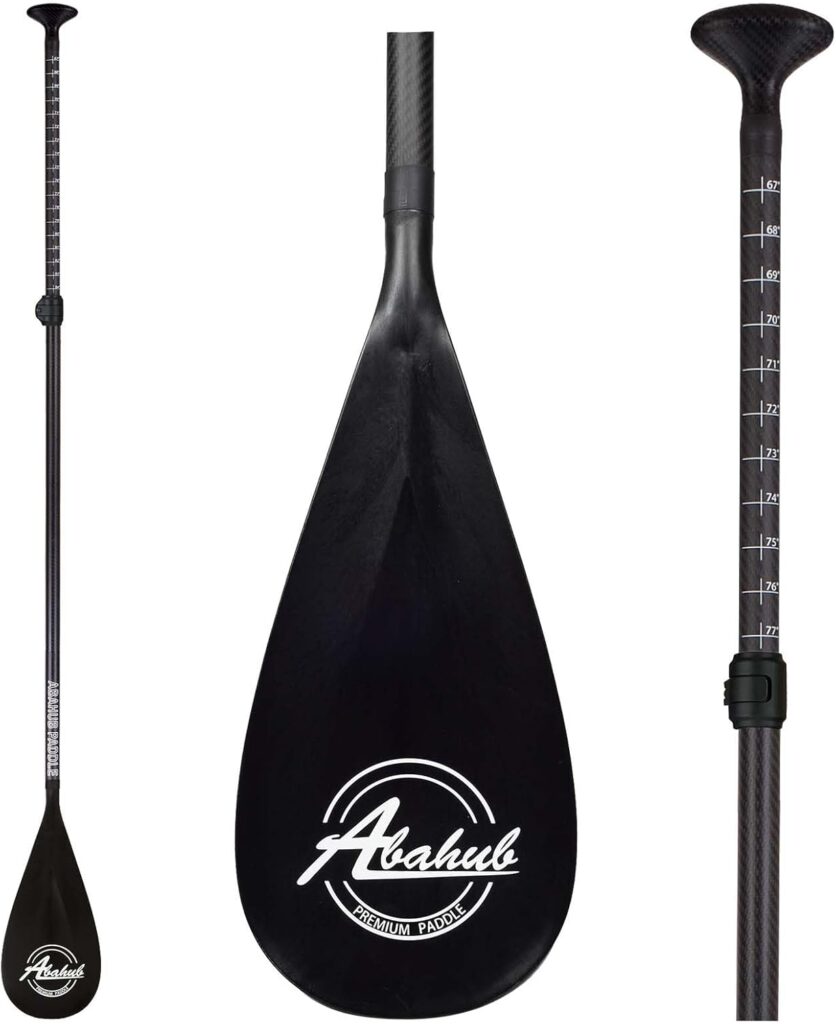
Material: Full carbon fibre shaft | Sizes: Adjustable 67″–86″ | Carry bag included
The full carbon construction brings weight into the range where you genuinely notice it over a two-hour session: lighter per stroke, less shoulder fatigue, cleaner exits.
The 67″–86″ adjustment range is among the widest available, which means this paddle works well across a broad range of paddler heights and can comfortably transfer between users of different builds. The carry bag is a practical inclusion that most competitors at this price omit.
The honest caveat: This is the upper end of what a beginner should spend on a paddle. Above this price point, you’re paying for marginal gains that take intermediate-to-advanced technique to even notice. If you’re not yet consistently executing a clean forward stroke, the extra weight saving won’t make a visible difference to your performance — but it will make a difference to your comfort on longer paddles.
Best for: Fitness-focused paddlers who plan to be on the water regularly and want gear that won’t limit them as their technique improves.
Paddle Care: Three Things That Actually Matter
SUP paddles are more durable than they look, but a few habits extend their lifespan significantly.
Rinse after saltwater use. Salt accelerates corrosion in the adjustment collar and degrades blade decals. A 30-second rinse after each ocean session costs nothing and adds years of reliable adjustment function.
Don’t use the blade as a push-off tool. The instinct to push off from a dock, rock, or shallow seabed with the blade face is strong and almost universal among beginners. A blade rated for water resistance is not rated for point-load pressure against a concrete dock edge. This is the most common cause of early blade cracking.
Store horizontally or hanging. Long-term storage leaning at an angle — particularly for carbon paddles — can introduce a slight shaft warp over months. Horizontal or suspended is the correct position.
A Note on Mediterranean Paddling
Paddle choice matters more in certain conditions than others, and the Mediterranean coast — particularly Turkey’s Aegean side — presents a specific pattern worth understanding before you travel.
Morning conditions on sheltered bays like those around Selimiye and Göcek are typically glassy and forgiving: ideal for technique work regardless of what paddle you’re using. By mid-afternoon, thermal winds build across the water surface, turning a casual return paddle into a genuine workout.
In those conditions, paddle weight and blade efficiency become tangible rather than theoretical. A 200g weight difference between an aluminium shaft and a fibreglass one is academic in flat water; paddling directly into a 12-knot thermal wind for 800 metres, it becomes the conversation you’re having with your arms.
If you’re planning a Mediterranean SUP holiday and buying gear specifically for travel, prioritise an adjustable paddle that collapses small — your board bag will thank you at the airport.
The Bottom Line
For most beginners, the decision is straightforward: spend at least £80, choose adjustable, choose fibreglass or carbon, and go slightly smaller on the blade than your instincts suggest.
The Trail fibreglass is the recommendation I’d make to nine out of ten people asking this question for the first time. It’s the paddle that doesn’t get in the way of learning — which is exactly what you need in your first season.
If you’re not ready to commit that much yet, the Abahub aluminium is a low-risk starting point.
If you already know you’re serious and plan to paddle regularly, the Abahub full carbon with the carry bag is gear you won’t outgrow.
Everything else is detail.
Disclosure: Some links on this page are affiliate links. If you purchase through them, we may earn a small commission at no extra cost to you. We only recommend gear we’d genuinely put in a beginner’s hands.