
How to Stand Up Paddle Board: A Complete Beginner’s Guide (2026)

Standing up on a paddle board is far easier than it looks. Most first-timers are up and paddling within their first 20 to 30 minutes on calm water — and it has almost nothing to do with strength. Balance on a SUP comes from two simple things: where you place your feet, and where you look.
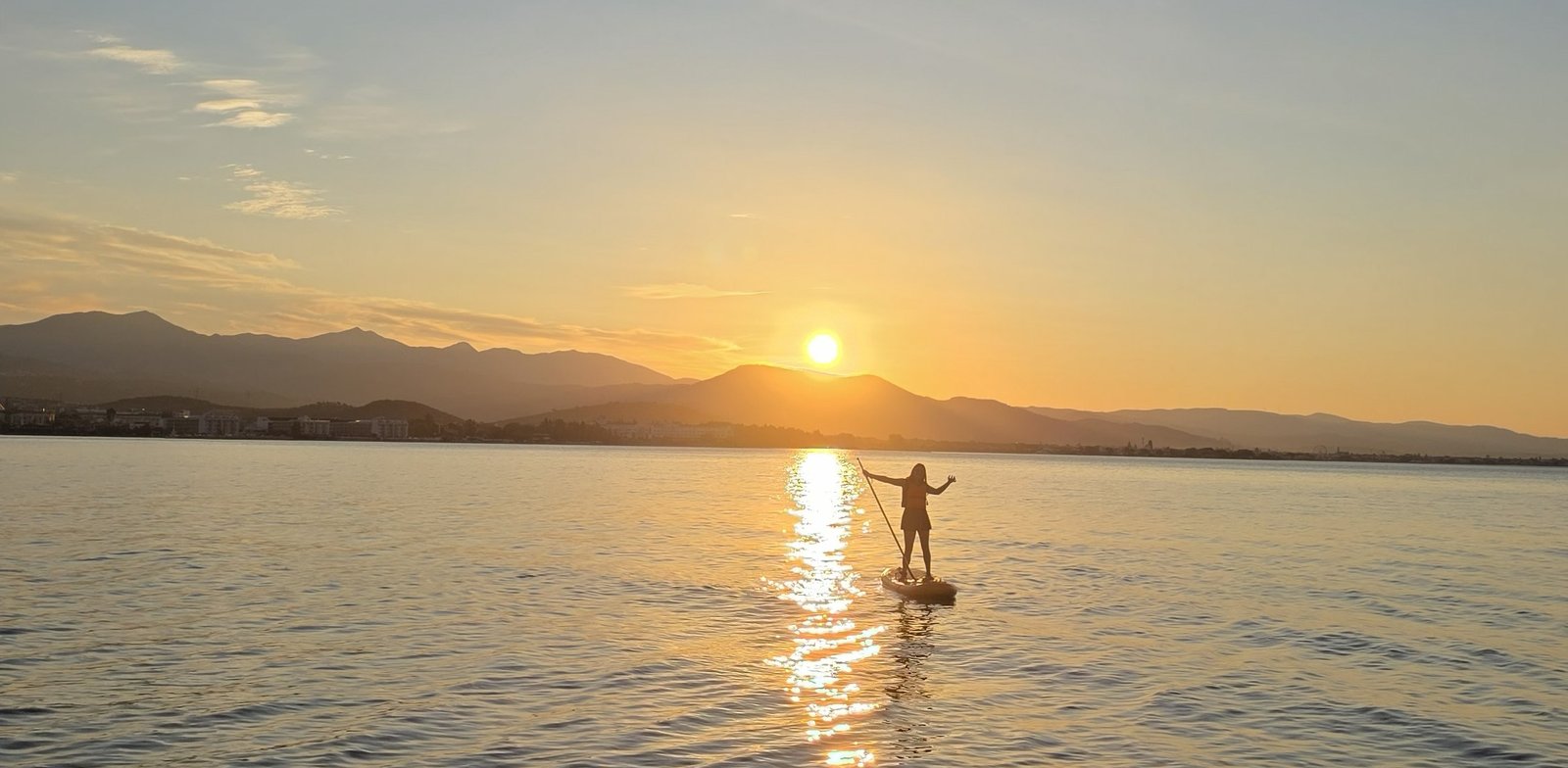
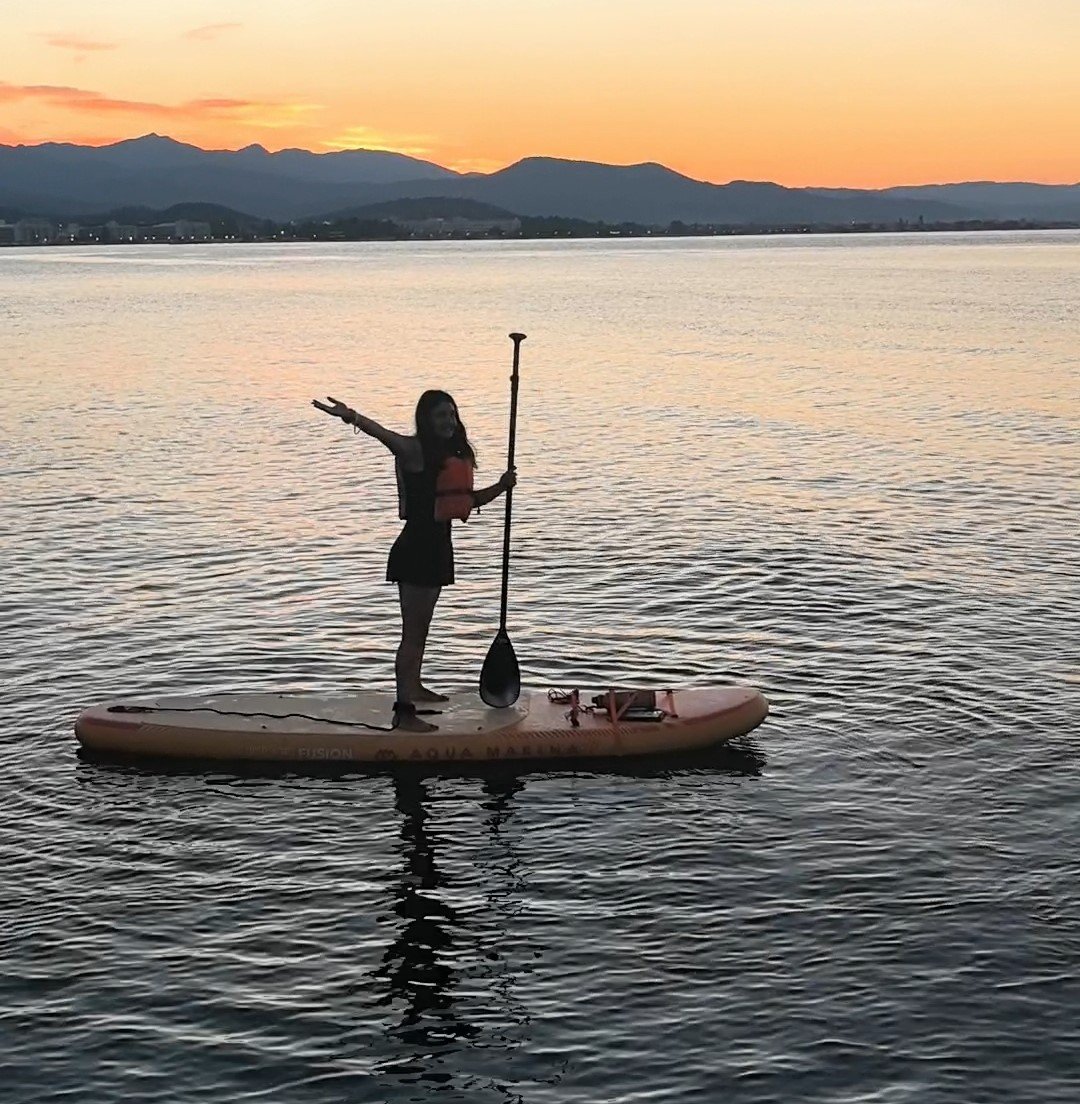
This guide walks you through the exact sequence I use to get from the water to standing, one move at a time. The photos are from a still evening on the Turkish Aegean, on the same beginner-friendly inflatable I still paddle today — no models, no stock footage, just the real progression from kneeling to standing tall.
What you need before you stand up
You need less than most beginners assume, but the few things you do need matter. A wide, stable board (30–34 inches) turns balance from a fight into a formality. A lightweight adjustable paddle saves your shoulders. And two items are non-negotiable, in calm water as much as rough: a leash that keeps your board — your largest flotation device — tethered to you, and a PFD.
The beginner starter kit
- A wide, stable board — width and volume beat length for stability
- A lightweight adjustable paddle — set it 6–10 inches above your head
- A PFD and leash — the two things you never skip
- A good pump — firm 14–15 PSI makes a board feel rigid underfoot
Mediterranean Angle
Your first session lives or dies on water conditions. Sheltered Aegean bays are glassy just after sunrise, before the afternoon thermal wind builds — which is exactly when a beginner should be learning. Flat water gives honest feedback without punishing every wobble.
How to stand up on a paddle board
There are four moves, and they happen in order. Rushing straight to standing is the single most common reason beginners fall. Work through them one at a time and the last step arrives almost on its own.
Get comfortable before you stand
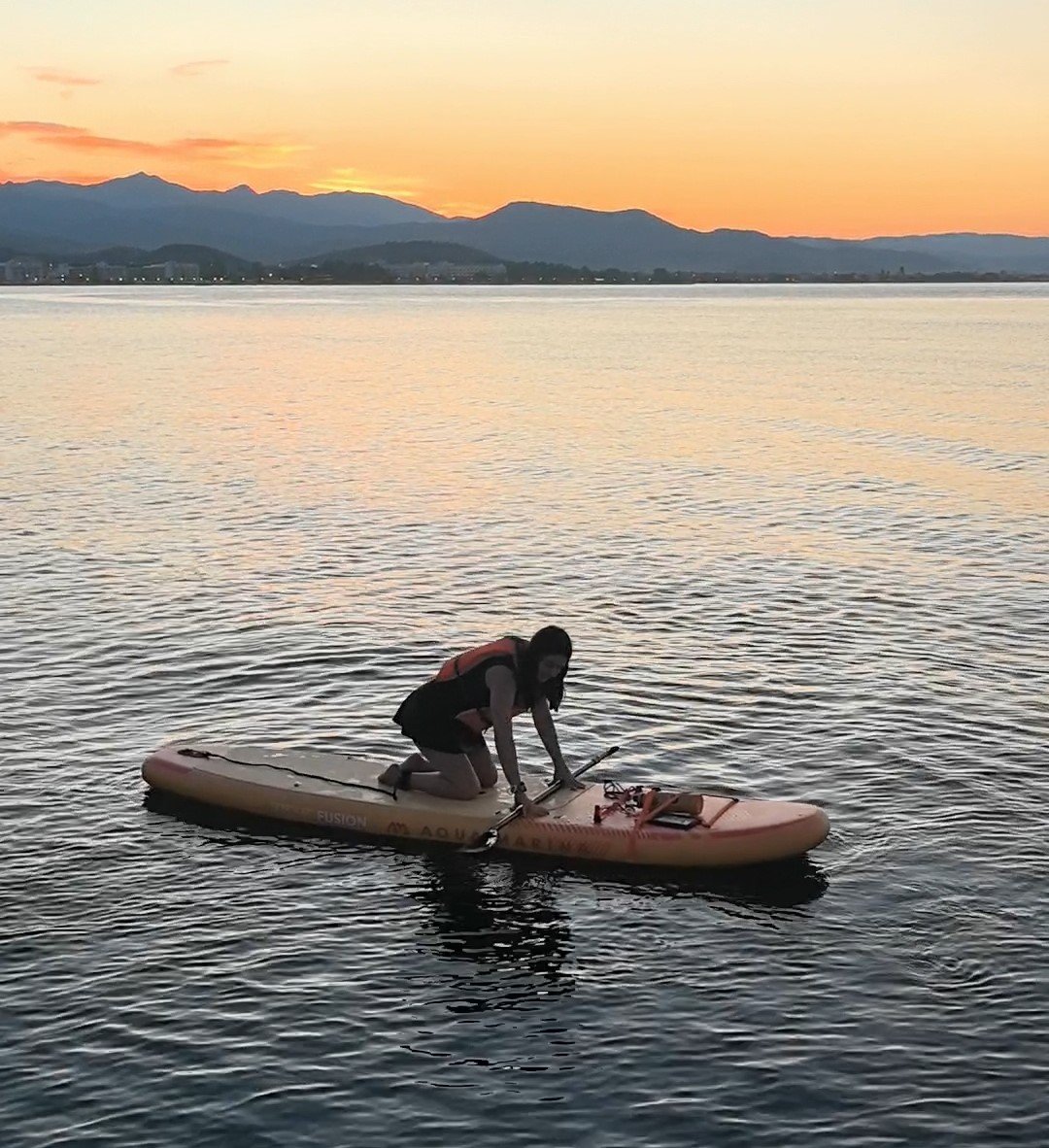
Climb on from the side in shallow water and settle into a kneeling position, with your knees hip-width apart and centered on either side of the carry handle. That handle marks the board’s center of gravity — your neutral zone.
Take a few paddle strokes on your knees first. Feel how the board responds before you ask anything harder of it.
Hands down, board settled
Place both hands flat on the board in front of your knees and let the board stop rocking. This braced, hands-down position is your launchpad — stable, low, and centered over the handle.
Don’t move on until the board is genuinely still. A calm board makes the next step feel like nothing.
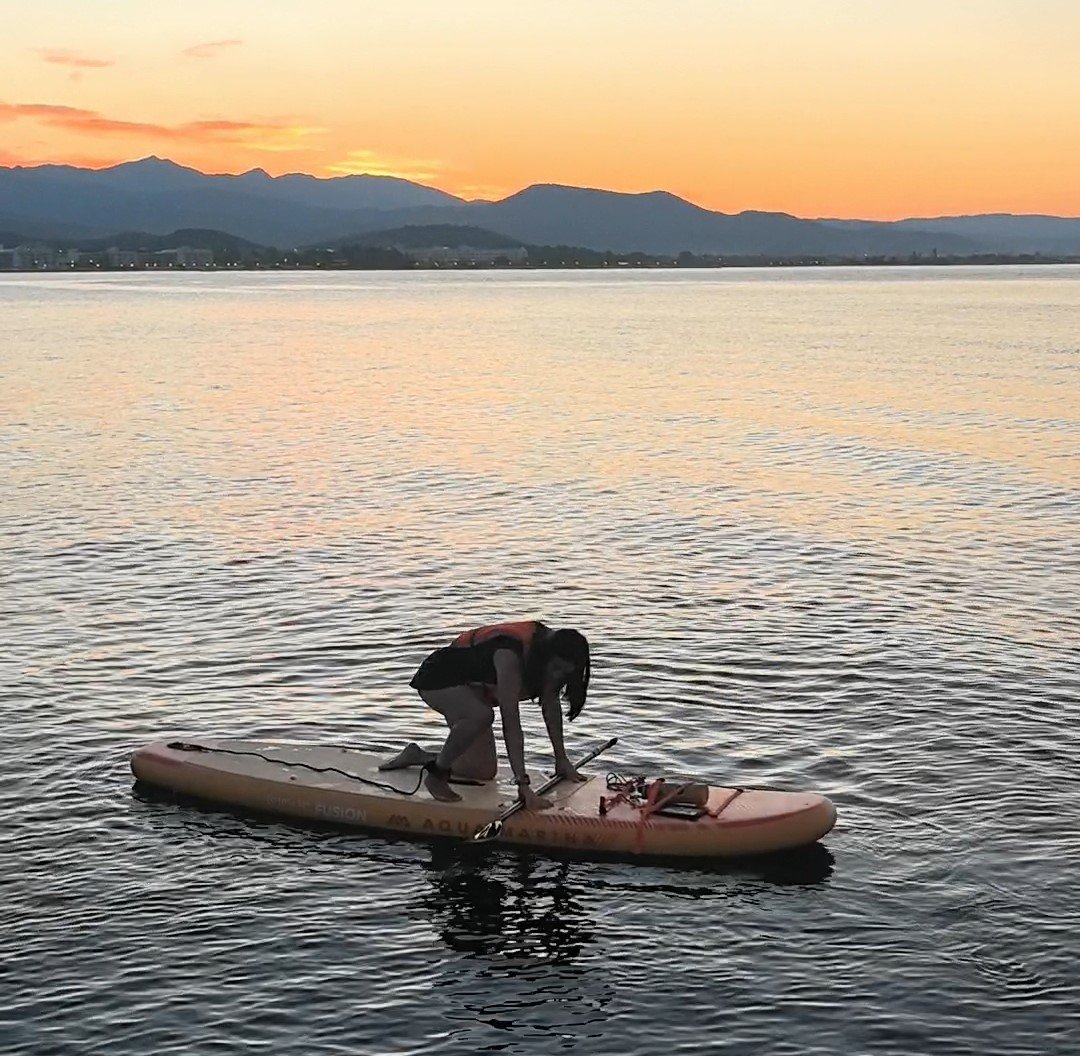
Move into a low crouch
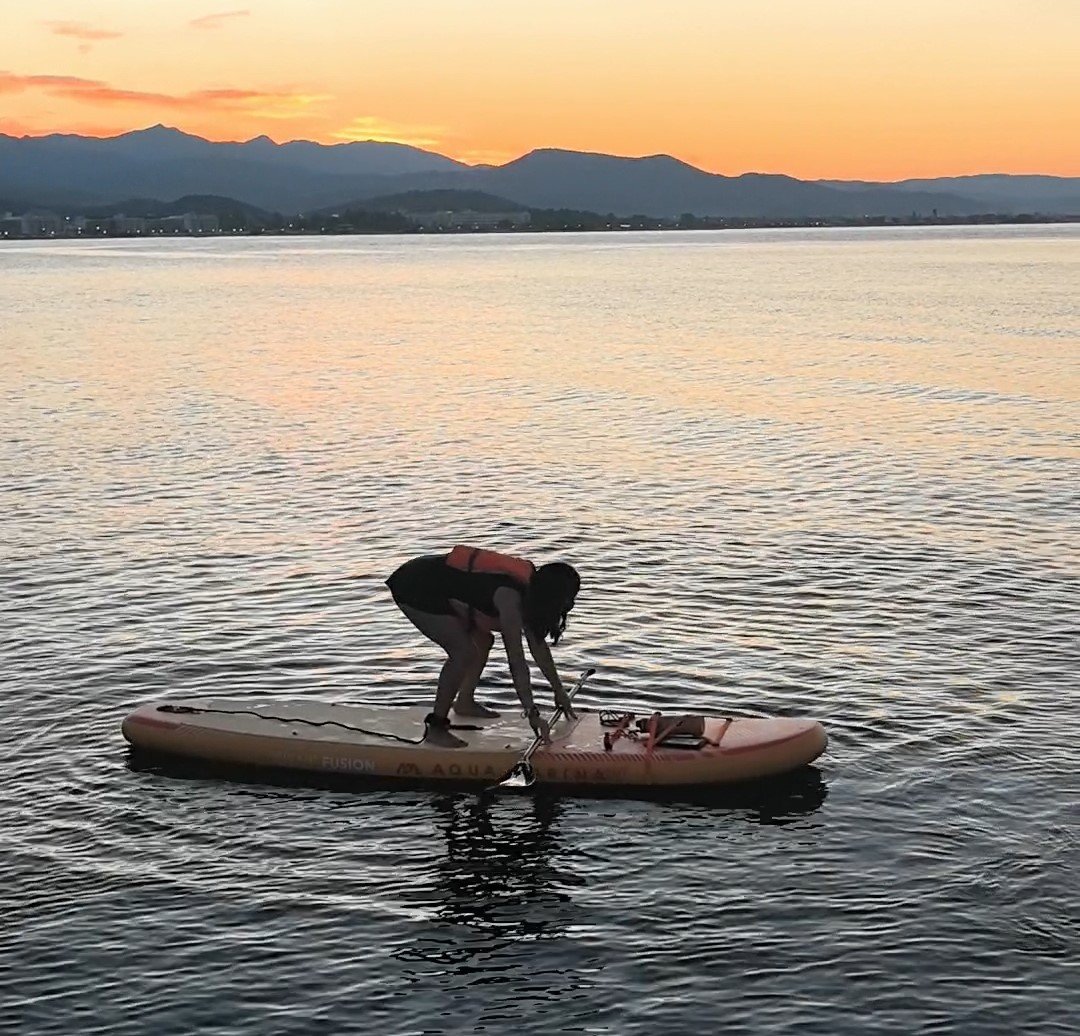
From your hands-down position, bring one foot up and plant it flat exactly where that knee was — then the other. Feet land parallel, shoulder-width apart, centered over the handle. Stay in a low crouch with your hands ready, not fully upright yet.
This crouch is the hardest-looking moment and the easiest to get wrong by hesitating. Commit to it in one smooth motion.
Rise slowly and look ahead
Push up from the crouch with your hips coming over your feet. Keep a slight bend in your knees, and fix your gaze on the horizon — not on the board. That single habit does more for your balance than anything else.
That’s it. You’re stand up paddle boarding. Now stay loose and let your knees absorb the small ripples the water sends up.
The board isn’t trying to throw you off. The moment you stop looking down and trust your feet, it holds you up.
3 mistakes that put beginners in the water
Almost every first-session swim traces back to one of these three habits. Fix them and your success rate climbs immediately.
Your first paddle strokes
Once you’re up, three strokes give you full control. Clean exits matter more than powerful entries — pull smoothly and lift the blade out cleanly rather than hauling hard.
The forward stroke
Plant the blade in the water ahead of you, pull it back to your ankle, then lift it out. This is your engine. Keeping the paddle vertical and close to the board stops the zig-zag that tires beginners out fastest.
The sweep stroke (to turn)
Arc the blade in a wide C-shape from nose to tail. It spins the board without you constantly switching sides — the efficient way to change direction.
The reverse stroke (to stop)
Drag the blade backward from hip to nose. It’s your brake and your tight-pivot move when something appears in front of you.
How to fall — and get back on — safely
Falling isn’t failure; it’s part of learning. Doing it well just means choosing the water over the board. A board edge to the shin is far worse than a quick swim.
When you feel the tip coming
- Fall away from the board, into open water — never onto the deck.
- Let go of the paddle. It floats, and you’ll collect it in a second.
- Trust your leash to keep the board within arm’s reach.
- Climb back on from the side, over the center, kicking your legs up like getting out of a pool.
- Reset on your knees before standing again.
Where to learn on calm water
The right water makes every lesson above easier to absorb. You want a sheltered, enclosed bay with flat morning water and enough space that a wobble isn’t a problem. The Turkish Aegean is full of them — and paddling somewhere beautiful is its own kind of motivation.
If you’re planning a trip, three of my favourite beginner-friendly spots are already written up: the sheltered hidden bay of Bencik Koyu, the atmospheric shipwreck route out of Ayvalık, and the surreal experience of paddling beside the Roman ruins of Soli Pompeiopolis.
One rule that beats every other tip
Check a marine forecast, not a general weather app, and paddle early. A 15 mph afternoon headwind turns an easy return into a grind — while the same bay at 7 a.m. is a mirror. Wind, not waves, is the thing that catches beginners out here.
Beginner questions, answered
Is stand up paddle boarding hard for beginners?
No. On calm, flat water most beginners stand up and paddle within their first 20 to 30 minutes. It’s a balance-and-technique sport, not a strength sport — starting on your knees and choosing sheltered water makes it approachable for almost anyone.
How long does it take to learn to SUP?
You can learn to stand and paddle in a single session. Feeling genuinely confident in light chop or a breeze usually takes a handful of sessions. The core skill — balancing over the board’s center with your eyes up — clicks quickly and stays with you.
Do I need to be fit or strong to paddle board?
No. SUP relies on balance and technique rather than raw strength. Your core and legs engage naturally to keep you stable, which is why paddlers describe it as a low-impact full-body workout, but you don’t need to arrive fit to start.
Where should I put my feet on the board?
Parallel, roughly shoulder-width apart, and centered on either side of the carry handle. The handle sits at the board’s balance point, so feet placed there keep the nose and tail level and the board stable.
Can I paddle board if I can’t swim?
You should always wear a properly fitted PFD and a leash, and this matters even more if you’re not a confident swimmer. Stay in shallow, calm, near-shore water and consider a lesson with a reputable operator. Your board is your largest flotation device — the leash keeps it with you.
What should I wear to go paddle boarding?
Quick-dry clothing you don’t mind getting wet, a PFD, and a leash. Add sun protection — SPF, a hat, and more water than you think you need. Reflected light off the water intensifies UV, and dehydration creates fatigue that feels a lot like bad technique.
Key takeaways
- Kneel first. Standing straight away is the number-one cause of beginner falls.
- Feet over the carry handle. That’s the board’s balance point — the whole game is staying centered on it.
- Eyes on the horizon, knees soft. Look up and stay loose and the board holds you.
- Fall away from the board, wear a leash and PFD. Non-negotiable, even on glassy water.
- Pick calm morning water. Flat, sheltered bays are where real technique gets built.