
How to Store a Paddleboard: Inflated or Deflated?

Store an inflatable paddleboard deflated, rinsed and completely dry, loosely rolled in its bag, indoors where the temperature stays steady and the sun never reaches it. Leaving it inflated is fine for a few days between sessions, but let some air out and keep it in the shade. In summer heat, a fully pumped board left in the sun can burst. Hard boards go on a padded rack, out of the sun, with the vent plug cared for.
Ask five board makers how to store a paddleboard and you get five slightly different answers. One says inflatables are built to stay pumped up for long stretches. Another says deflate them for any long break. A third says neither: keep it on a rack at low pressure. They are all trying to protect the same two things, the seams and the PVC, from the same three enemies: heat, damp and sunlight.
I coach on inflatables and race one myself, so here is how I’d cut through it. The short version: for long storage, deflate. For daily use in summer, keep it inflated if you like, but never at full pressure in the heat. That second part is the one people get wrong, and I watched it cost a lot of boards this summer.
Should you store an inflatable paddleboard inflated or deflated?
For anything longer than a few days, deflated. For a board you use every day, inflated is fine as long as you drop the pressure and keep it out of the sun. That is my answer, but it helps to see where the brands disagree, because the advice on your own board’s manual wins over anything written here.
| Brand | Long-term inflated? | If you deflate it | Temperature |
|---|---|---|---|
| Red Paddle Co | Fine now and then, out of the sun. For long periods, deflate. | Roll from the nose, loosely, no sharp creases | Avoid extreme heat and cold |
| Starboard | Most inflatables are built to stay fully inflated for long periods | Optional, mainly to save space | Cool, dry, out of direct sun |
| Aqua Marina | Either works. If inflated long-term, let a few PSI out | Loose roll, in the bag, lying on its side | 5°C to 40°C |
| Mistral | Best of all: low pressure, on a rack, top side up, never hung from ropes | Fold towards the valve, leave the valve open | Warranty excludes long storage above 30°C or below 2°C |
| Paddle North | In a cold, unheated space: partly inflated, 4 to 6 PSI | Unrolled or very loosely rolled when it’s cold | Cold makes tight folds risky |
If you won’t paddle for more than a week, deflate it. Rinse, dry, roll loosely, bag it, and keep it indoors. If you paddle daily, leave it up, but at a lower pressure and in the shade. A rack at low pressure is the gold standard if you have the wall space.
The brands differ on pressure, but they line up on the rest: store it dry, keep the sun off it, and keep it away from extreme heat and cold.
Off season, my board lives deflated in its bag, in a room at normal indoor temperature. Nothing clever. It is dry, it is dark, and the temperature hardly moves, which is all any of the brands above are really asking for.
Why do inflatable paddleboards burst in the heat?
Because the air inside expands as it warms, and an inflatable has almost nowhere to grow. Drop-stitch construction holds the top and bottom skins at a fixed distance, so the board barely changes shape. The pressure climbs instead. Pump a board to 15 PSI on a mild morning, leave it lying in the midday sun, and the air inside it heats up well past the temperature you pumped it at.
The board makers know this. Mistral’s manual tells owners to check the pressure and let air out after the board has been in hot sun, and Aqua Marina advises releasing a few PSI from any board stored inflated, in case the space gets warm.
I watched a lot of inflatable boards burst this summer, left pumped up in the heat. Several of them belonged to friends, and in those cases the board had only been sitting in the sun for an hour or two. It happens far more easily than people think.
If you are not going to deflate it after every session, at least let some air out for the summer. The air expands a lot in the heat, and a board at full pressure has nowhere left to go.
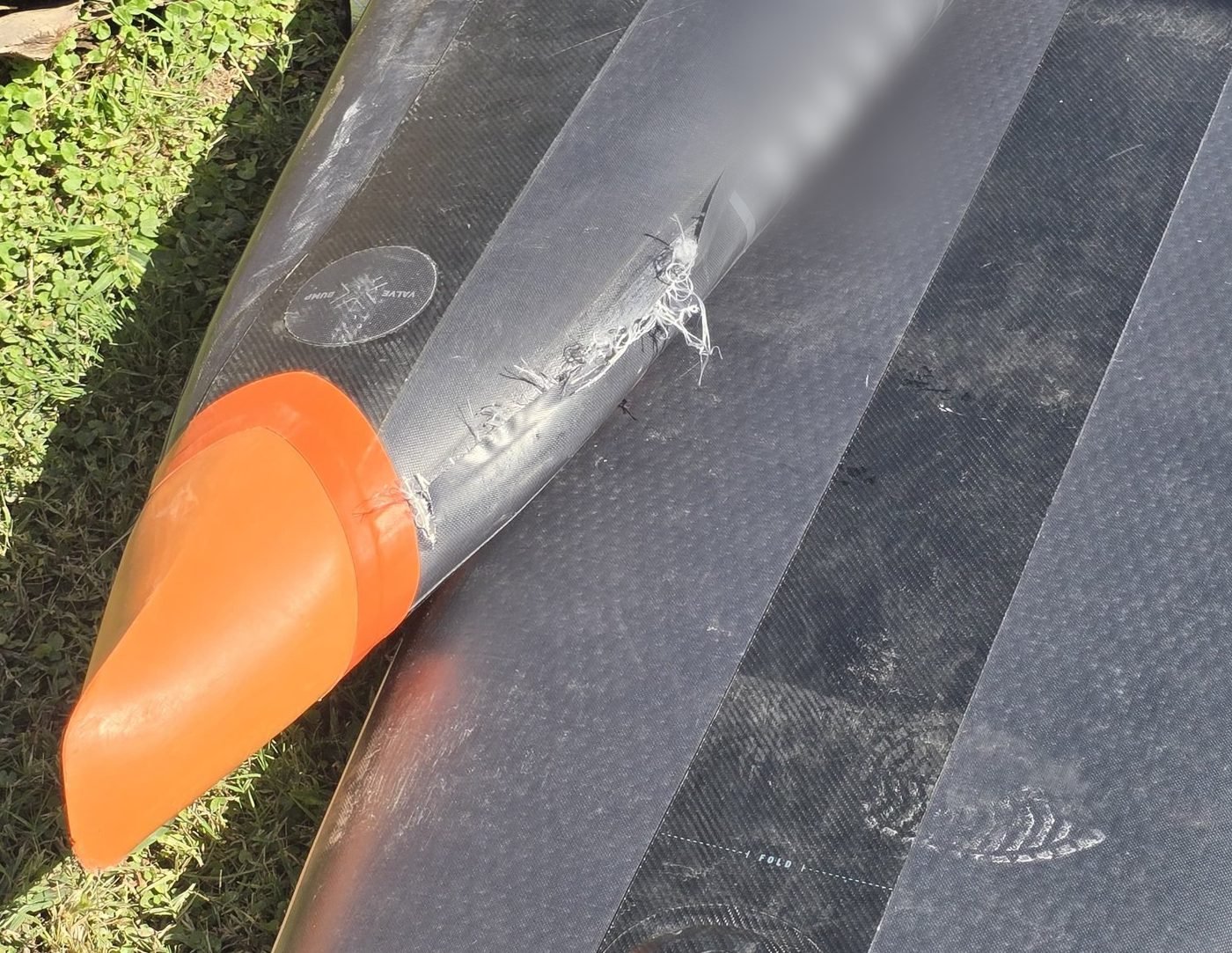
How hot does a board actually get?
Hotter than the air around it. In a study by researchers from Arizona State University and UC San Diego, cars parked in the sun on Arizona summer days, with outside temperatures of roughly 33 to 42°C, reached an average cabin temperature of nearly 47°C after one hour, with dashboards at about 69°C. A board sitting in a hot car, on a car roof, or on dark ground in full sun is in the same kind of oven. You don’t need numbers that extreme to get into trouble, though, as the calculator below shows.
How much does the pressure rise in the sun? A heat check
Set the pressure you pumped to, the temperature you pumped it at, and how hot the air inside might get. Then compare the result with the maximum printed on your board, usually on the valve patch.
If the sliders don’t work in your browser, here are the same sums worked through for two common starting pressures, both pumped at 22°C:
| Air inside reaches | Pumped to 15 PSI | Pumped to 18 PSI |
|---|---|---|
| 30°C | 15.8 PSI | 18.9 PSI |
| 40°C | 16.8 PSI | 20.0 PSI |
| 47°C (the hot car cabin above) | 17.5 PSI | 20.8 PSI |
| 55°C | 18.3 PSI | 21.7 PSI |
The pattern matters more than the decimals. The higher you pump, the closer you already are to your board’s limit, so the same hot hour pushes a firm board over the edge sooner. That is why I pump lower in the heat in the first place.
How do you store a paddleboard between sessions in summer?
If you paddle most days and don’t want to deflate and pump up every time, keep it inflated, but do three things: pump it a little lower than you would in cool weather, let air out the moment you’re done, and keep it in shade. Here is what that looks like in practice.
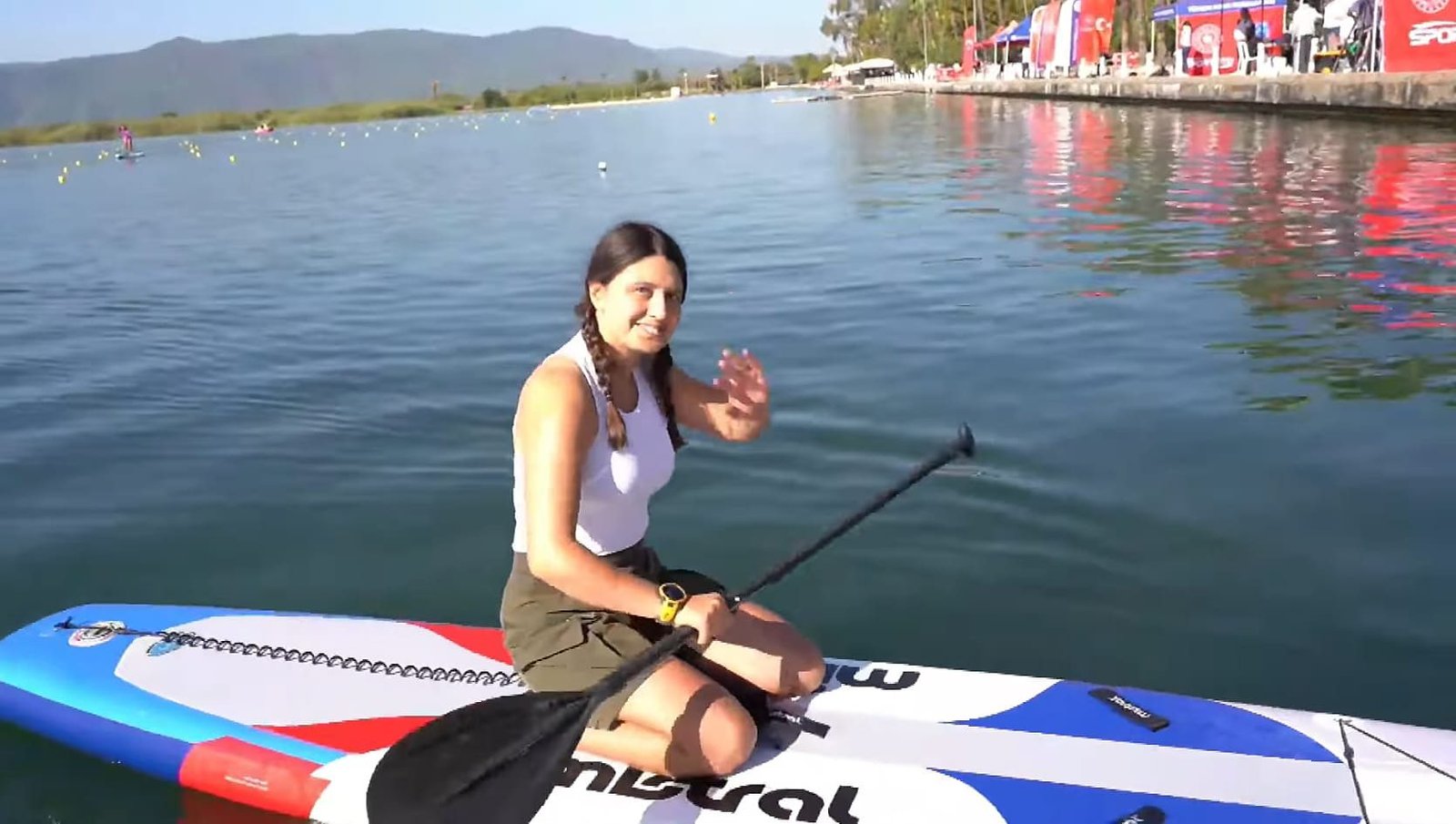
My Mistral inflatable race board is rated 18 to 20 PSI. In the summer heat I pumped it to around 15 instead, and as soon as I was off the water I let it down to roughly half pressure and kept it in the shade until the next session.
Even in shade, I wouldn’t leave a board sitting at high pressure on a hot day.
When I worked in Datça, the boards were kept inflated at medium pressure, in the shade, stacked on top of each other. Not pumped hard, and not in the sun.
Stay inside your board’s printed range, just not at the top of it, so a warm afternoon has room to push it up.
Half pressure or less while it waits. It takes seconds and you top it back up before the next paddle. Our SUP pump guide covers which pumps make that top-up painless.
Under a tree, a roof or a covered terrace. Not on a car roof, not in a parked car, and not lying on hot sand or decking.
Mistral’s warranty specifically excludes damage from saltwater crystals and from not rinsing after use. A quick fresh-water rinse is the cheapest maintenance there is.
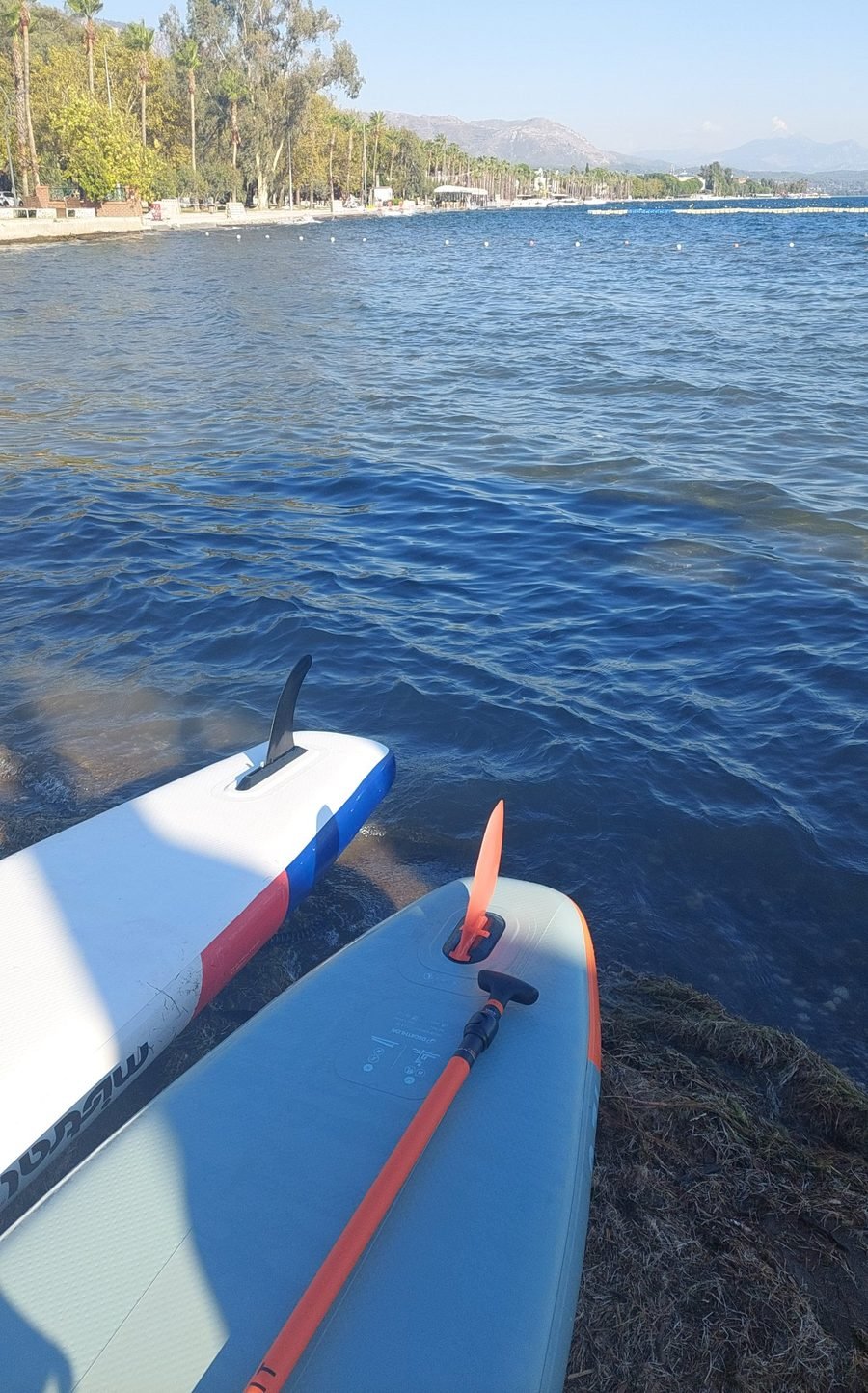
Two boards pulled up on the shore between sessions. For a short stop, this is normal.
On a midsummer afternoon, though, this is exactly where a fully pumped board starts gaining pressure: full sun, no shade, nobody watching it. Pull it into the shade and let some air out.
On the Turkish coast, summer is the storage season that breaks boards
In the UK, storage means winter. On Turkey’s Aegean and Mediterranean coast it is the other way round. Mistral’s warranty draws its line at 30°C for prolonged storage, and in Muğla, the province that covers Bodrum, Marmaris, Fethiye and Datça, the average daily high stays above 30°C from June to September. In Antalya it is above 30°C for the same four months.
So if you live on this coast, or you’re here for a summer of paddling, the routine above is not optional extra care. It is the main thing. For the travel side, our guide to taking a paddleboard to Turkey covers flying with a board and renting one here instead.
How do you store an inflatable paddleboard over winter?
Clean it, dry it completely, deflate it, roll it loosely and keep it indoors somewhere dry with a steady temperature. Damp is the winter enemy, the way heat is the summer one. Mistral’s warranty excludes damage from storing a board wet, damp or humid inside its bag, and from storage in damp, dark rooms with no ventilation.
Salt, sand and mud all come off. Mild soap if it needs it, nothing harsh.
Towel it down and leave it in the air until every crease and handle is dry. Rolling a damp board is how mildew starts.
Aqua Marina asks for fins off before storage, and Mistral warns against folding along the edge of the fin box, which can deform it.
Red rolls from the nose; Mistral folds towards the valve so the last air is pushed out. Either way, keep it loose and avoid sharp creases. Check there is no sand between the folds.
Aqua Marina suggests the bag lies on its side rather than standing on end, so no single edge takes the weight. Nothing heavy on top.
Dry, in the same place, so spring setup is one bag and not a search.
If the only space is an unheated garage or shed, Paddle North advises against rolling the board tightly in the cold. Leave it unrolled, very loosely rolled, or partly inflated to 4 to 6 PSI so fold lines can’t set. Aqua Marina’s suggested range starts at 5°C, Mistral’s warranty excludes long storage below 2°C, and Kona Sports notes that PVC turns stiff and brittle in the cold.
Where is the best place to store a paddleboard?
Somewhere dry, dark and steady. The room matters less than those three words. Here is how the usual spots compare.
Steady indoor temperature, dry, dark. Exactly what the brands ask for.
Red and Glide both name a garage as a fine spot, as long as it stays dry and doesn’t swing between hot and cold.
iRocker rules out uninsulated sheds altogether. If yours is insulated and dry, keep the bag off the floor and away from the walls, where condensation collects, and watch for mice: iRocker warns rodents chew PVC and nest in deflated boards.
Glide and iRocker both rule attics out: hot in summer, cold in winter, the exact swings that tire glue and seams.
Fine for the drive. Not for storage. A parked car in the sun becomes an oven, and iRocker lists car boots alongside attics.
Sun and UV break down PVC over time. If outside is truly the only option, see the FAQ below.
It traps moisture. Glide warns airtight bins hold humidity in; a breathable bag is better.
Shade helps a lot, but hot air is still hot air. On a summer day I still let some out.
Not by itself. Starboard says most inflatables handle long inflation. Heat, sun and pressure together are the problem.
How do you store a hard paddleboard?
On a padded rack or padded hooks, off the ground, indoors and out of the sun. Heat is the danger here too, just in a different way. A hard board’s foam core is full of air, and when it heats up that air expands and pushes the fibreglass and epoxy skin away from the core. That is delamination, and it shows up as a soft spot or a bubble.
- Know your vent plug. Many hard boards have one to let that pressure out. Some are maintenance-free Gore-Tex vents; screw-in types are opened when the board is stored and closed before it goes back in the water.
- Keep the deck pad out of the sun. Tower Paddle Boards points out that a black deck pad soaks up heat and can lead to the deck delaminating, so flip the board if it has to sit outside for a while.
- Don’t leave it in a hot car or a board bag in the sun. ISLE notes a board bag isn’t meant for long stretches in direct sun. It protects from knocks, not from heat.
- Check for dings before winter. Any crack that lets water into the core is easier to fix now than after months in storage.
What should you check before the first paddle after storage?
A slow leak or a lifting seam is much easier to find at home than half a mile out. Five minutes before the first session of the season.
Leave it for a few hours and see if it holds. Spot leaks with soapy water: bubbles that keep coming mean air is escaping. Glide’s advice is to check the valve first; a loose one is tightened with the valve wrench from the repair kit.
Look along the rails for lifting or bubbling, and make sure the fin still locks in firmly.
Check the leash cord and velcro, and wear a buoyancy aid every session. Our SUP life jacket guide covers which ones are worth wearing.
The RNLI’s advice is to avoid offshore winds, which push you away from land while the water looks calm. If you’re back on the water before summer, check the water temperature too; our winter paddleboarding guide covers what to wear.
What do you need to store a paddleboard properly?
Mostly nothing you don’t already own: the bag the board came in, a towel and a dry corner. These three are the only extras worth buying, and only if they fit your situation. I haven’t tested these exact models. I picked each one because what its listing says it does matches what the board makers above ask for.
Two padded arms that hold the board flat, top side up, which is the low-pressure-on-a-rack method Mistral describes. The arms fold back against the wall when the board is out, there’s a paddle holder, and it’s rated to 45 kg.
A stretchy knit sleeve that keeps sun off the skin and knocks off the rails. It fits hard boards and inflatables, the fin can stay on, and it comes in sizes from 8’0″ to 12’0″, so pick yours. It cuts sun; it doesn’t replace shade or letting air out.
Made specifically for inflatable paddleboards: small holes, splits and stress cracks, with an adhesive that stays flexible once it cures. It has no valve wrench, but most boards ship with one; Mistral’s, for example, comes with a valve spanner. Keep that wrench with the kit, because Glide’s advice is to check the valve first when a board loses air.
Paddleboard storage FAQ
Is it better to store an inflatable paddleboard inflated or deflated?
For long breaks, deflated: Red recommends deflating for long storage to take the stress off the material. Some brands, Starboard among them, say their boards can stay inflated for long periods. If you do keep it inflated, let a few PSI out, keep it out of the sun and put nothing heavy on it.
Can you leave a paddleboard inflated all summer?
Yes, if you manage the heat. Pump it a little lower than usual, let air out after each session and keep it in the shade. A fully pumped board left in direct sun can gain enough pressure to burst; I saw it happen to several boards this summer after an hour or two in the sun.
Why do inflatable paddleboards burst in the sun?
The air inside expands as it heats, and drop-stitch construction stops the board growing, so the pressure rises instead: roughly 0.1 PSI for every degree. A board pumped close to its maximum has little headroom, and a dark board in full sun runs hotter than the air.
Can I store my paddleboard in the garage or shed?
A dry garage is fine. In a shed, keep the bag off the floor and away from the walls, watch for damp and mice, and avoid big temperature swings. In an unheated space, roll the board very loosely or leave it partly inflated rather than rolling it tight.
How cold is too cold to store an inflatable paddleboard?
Aqua Marina suggests storing between 5°C and 40°C, and Mistral’s warranty excludes long storage below 2°C or above 30°C. PVC stiffens in the cold, which is why tight folds are the main risk in a freezing garage.
Can you store a paddleboard outside?
Not long-term if you can avoid it, because sun and UV degrade the PVC. If it really has to live outside, Bluefin’s advice is to raise it off the ground and cover it to keep the sun off. In hot weather, lower the pressure too.
Should the valve be open or closed when the board is stored?
Mistral’s manual says to leave the valve open when storing a deflated, folded board. Brands differ, so check your own manual. Either way, make sure no water or sand is sitting around the valve before you roll it.
The boards I saw burst this summer didn’t fail mid-paddle. They failed sitting still, pumped up, in the sun. Deflate it for the long breaks, let air out in the heat, and keep it dry and out of the sun. That’s the whole job.
- Red Equipment (Red Paddle Co), 7 practical tips for paddle board storage and How to store your inflatable SUP over winter
- Starboard, Is it OK to leave an inflatable SUP inflated?
- Aqua Marina Help Center, How should I store my board?
- Mistral, Inflatable SUP manual and warranty
- Paddle North, How to store your inflatable paddle board during the winter
- Vanos, Middel, Poletti and Selover, Evaluating the impact of solar radiation on pediatric heat balance within enclosed, hot vehicles, Temperature 5(3), 2018
- Turkish State Meteorological Service (MGM), official statistics for Muğla and Antalya
- Glide, Storing your inflatable paddle board and How to fix your iSUP valve
- iRocker, Inflatable paddle board storage tips
- Bluefin, SUP storage: can I store my SUP inflated? and How to store your paddle board in winter
- Soulr Surfboards, Why do stand up paddle boards have air vents?
- Tower Paddle Boards, Paddle board care and maintenance
- ISLE Surf & SUP, Maintenance and care
- Kona Sports, Winter storage for your SUP
- RNLI, Stand up paddleboarding safety