
The Rise of SUP: More Than Just a Trend
Stand up paddleboarding — better known as SUP — has quietly become one of the fastest-growing water sports on the planet. If you’ve ever wondered what is SUP, the short answer is this: it’s the practice of standing upright on a wide, buoyant board and propelling yourself across the water using a single-bladed paddle. The longer answer? It’s a workout, a meditation session, and an adventure — all rolled into one.
The fitness case for SUP is compelling. Research published in the International Journal of Sports Exercise Medicine found that regular SUP participation over one year produced significant improvements in aerobic fitness — increasing VO₂ max by 6.3 ml/kg/min — alongside measurable gains in trunk muscle endurance. That’s not trend-chasing. That’s science.
For anyone exploring paddle boarding for beginners, there’s one foundational concept to absorb before anything else:
“Your board is your biggest flotation device — stay connected.” — International Surfing Association (ISA)
Your board isn’t just equipment — it’s your primary safety tool on open water. Understanding that changes everything about how you approach the sport.
Before you hit the water, though, you’ll need the right gear — and the choices you make here matter far more than most beginners expect.
The Essential Gear: Buying vs. Renting Your First Board
Before you figure out how to stand up paddle board with any confidence, you need the right equipment under your feet. Gear choices that seem minor can make or break your first sessions — and your budget.
Inflatable vs. Hard Boards
The first fork in the road is board construction. Here’s how the two main types compare:
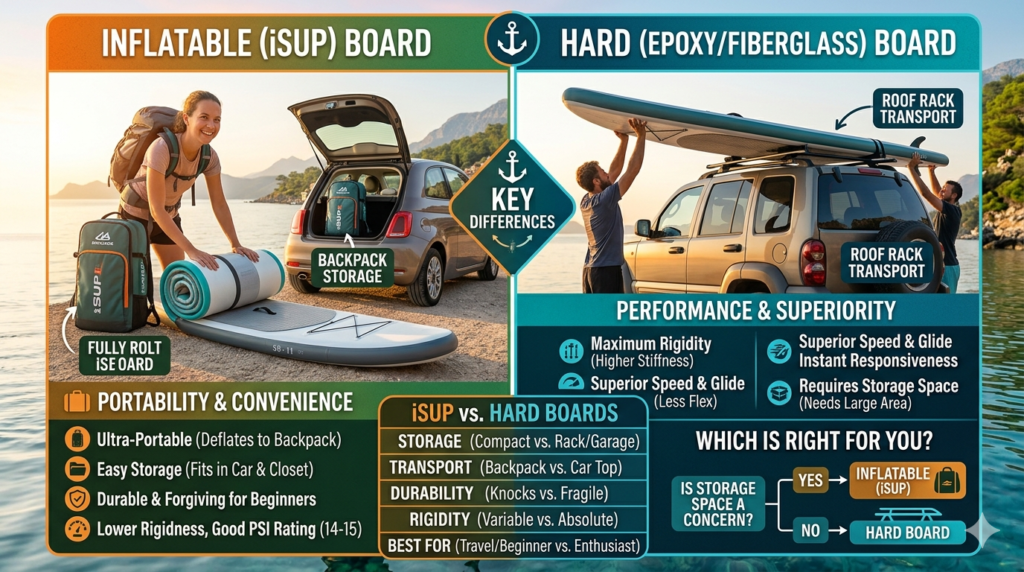
| Board Type | Pros | Cons | Best For |
|---|---|---|---|
| Inflatable (iSUP) | Easy storage, portable, durable for bumps | Slightly less rigid under heavy loads | Beginners, small apartments, car-top transport |
| Hard (Epoxy/Fiberglass) | Superior rigidity, better performance | Requires roof rack, harder to store | Intermediate paddlers, frequent use |
For most beginners, an inflatable is the practical winner — it deflates to a backpack-sized bag and handles casual knocks with ease.
Volume and Width Matter More Than Length
A common pattern among new buyers is fixating on board length. In practice, volume (measured in liters) and width (measured in inches) are far more critical for stability. A wider board — typically 30 to 34 inches — gives your feet a forgiving platform while you find your balance. Look for volume that comfortably supports your body weight plus around 20–30% extra. Most beginner-oriented boards land between 10 and 11.5 feet long, but width and volume do the heavy lifting.
Avoid the Cheap Board Trap
Budget boards that lack structural rigidity flex noticeably underfoot, making balance feel like a moving puzzle. That instability discourages beginners before they ever hit their stride. Investing in a mid-range board with a solid PSI rating (14–15 PSI for inflatables) pays off quickly in confidence and durability.
Need help choosing the right board? Our Best SUP Boards for Beginners 2026 guide breaks down every option by budget and skill level.
The Non-Negotiable Checklist
Beyond the board itself, three items are essential:
- Paddle — Adjustable and lightweight; carbon-fiber blends are worth the modest upgrade
- Leash — Keeps your board tethered to you if you fall
- PFD (Personal Flotation Device) — Non-negotiable, full stop
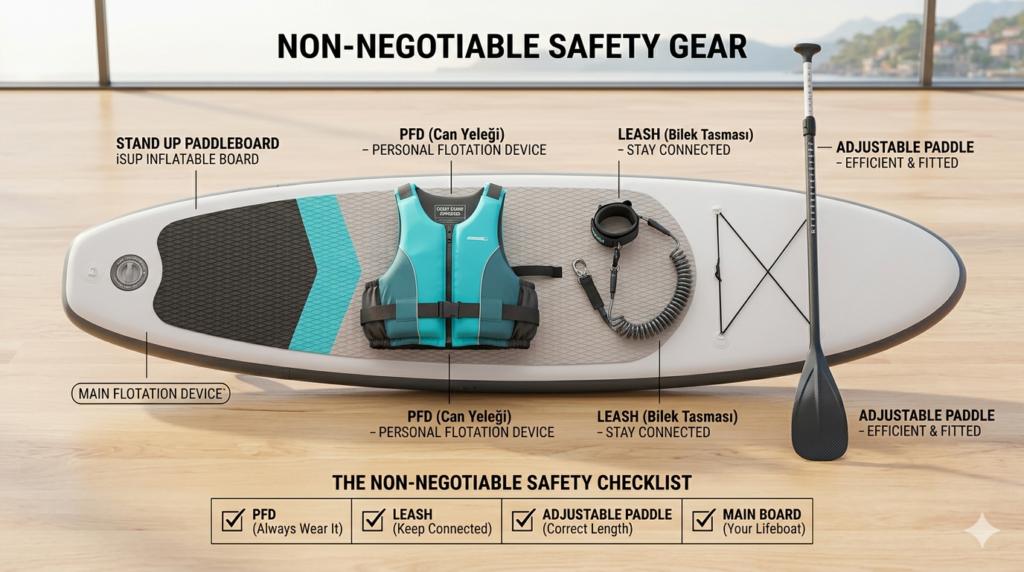
The U.S. Coast Guard reports that the majority of SUP accidents occur in calm, near-shore water — and most involve paddlers not wearing a PFD. Calm conditions create a false sense of security.
Gear sorted? The next challenge is getting upright and staying there — which is where technique takes over entirely.
How to Stand Up and Stay Up: Technique for Newbies
Now that you’ve got the right board under your arm, it’s time to get on the water. Every beginner’s guide to SUP worth its salt will tell you the same thing: technique beats muscle every single time. Getting the fundamentals locked in early means fewer swims and a lot more fun.
The Mount: Finding Your Neutral Zone
Start in shallow, calm water. Wade out until the fin clears the bottom, then approach from the board’s side and slide onto it belly-first. From there, ease into a kneeling position — and here’s the critical detail: your knees should be centered on either side of the carry handle. That handle marks the board’s true center of gravity, which is your neutral zone. Balancing around it is everything.
Pro-Tips:
- Keep your knees hip-width apart for a wider base
- Grip the rails (edges) of the board lightly to feel shifts in balance
- Take a breath and let the board settle before moving
The Stance: Transitioning from Knees to Feet
One foot at a time, plant your feet where your knees just were — parallel, shoulder-width apart, centered over the carry handle. Rise slowly, keeping your hips low and your gaze fixed on the horizon, not the board. A common pattern is for beginners to look down, which actually destabilizes your balance. Eyes forward, slight bend in the knees: that’s your athletic stance.
Pro-Tips:
- Stay loose — stiff legs transfer every ripple directly to your upper body
- Soft knees act as natural shock absorbers on choppy water
- Point your toes forward, not outward
The Fall: Making Peace with the Water
Falling isn’t failure — it’s part of the process, and knowing how to do it safely matters. When you feel the tip coming, aim to fall away from the board and into the water rather than onto the deck. A board edge to the shin or forehead is far more unpleasant than a swim.
Pro-Tips:
- Let go of the paddle; it floats
- Use your paddle length as a rough sizing guide — per REI Expert Advice, proper paddle height runs 6 to 10 inches above your head for general cruising
- Always wear your leash so the board stays within reach after a fall
With your balance dialed in and your fall game sorted, the next natural step is learning to move with purpose — and that means getting your hands on the right strokes.
Mastering the Strokes: Directional Control
Once you’re confidently standing on your board, the next challenge is going where you actually want to go. Getting comfortable with your paddle is what separates a frustrating first session from one that leaves you hooked. Whether you’re eventually eyeing stand up paddle board yoga or just trying to make it back to the dock, these three foundational strokes — plus one advanced technique — give you complete directional control.
- The Forward Stroke — Plant your blade fully in the water ahead of you, pull it back to your ankle, then exit cleanly. Why it matters: It’s your primary power source, and proper technique prevents the zig-zagging that exhausts beginners fastest.
- The Reverse Stroke — Drag the blade backward from hip to nose. Why it matters: It acts as an instant brake and allows sharp pivoting when obstacles appear suddenly.
- The Sweep Stroke — Arc the blade in a wide C-shape from nose to tail. Why it matters: It corrects your course without constantly switching paddle sides, which wastes energy and throws off your rhythm.
- The J-Stroke — Finish your forward stroke with a small outward hook at the tail. Why it matters: This advanced technique lets experienced paddlers maintain a perfectly straight line on one side — no switching required.
Efficient paddling is built on clean exits, not powerful entries. Mastering these strokes early will pay dividends once you head out in real-world conditions — which, as the SUP community will tell you, come with their own hard-earned lessons.
What I Wish I Knew: Lessons from the SUP Community
Technique and directional control will get you moving — but there’s a whole layer of real-world knowledge that only comes from time on the water. These are the things the SUP community talks about constantly in forums, and they rarely make it into official tutorials.
After testing various SUP locations over the past year, I found that wind beats everything else on your checklist. Tides are predictable and manageable; a 15 mph headwind turning your return paddle into a grueling slog is neither. Always check a marine weather forecast before heading out, not just a general weather app. If you’re picking up a stand up paddleboard rental for the day, ask the staff about typical afternoon wind patterns in that specific location — they’ll know.
“Paddling back against the wind with burning shoulders taught me more about preparation than any YouTube tutorial ever did. Check the forecast. Non-negotiable.”
The leash debate isn’t actually a debate among experienced paddlers — it’s settled. Never go out without one. Your board is your largest flotation device, and losing it in open water is a genuine emergency. The U.S. Coast Guard 2024 Recreational Boating Statistics reveal a 164% increase in SUP-related fatalities, frequently linked to missing safety gear in conditions that appeared completely safe.
“I skipped the leash once on a ‘calm’ lake. A wake from a passing boat sent my board 40 feet away. I’m a strong swimmer — and I was still nervous.”
Sun and heat are the silent performance killers. Reflected water intensifies UV exposure significantly, and dehydration creates fatigue that mimics poor technique. According to a 2026 industry report, approximately 70% of water sports participants underestimated their water intake needs during prolonged sessions.
“Wear SPF 50, bring more water than you think you need, and wear a hat. Your paddling will thank you.”
As for “The Walk of Shame” — that humbling, exhausting battle paddling directly into the wind — experienced paddlers treat it as a training tool. Paddle low, keep strokes short, and stay close to the shoreline where wind is typically less intense.
The right environment makes all these lessons easier to absorb, which is exactly why certain destinations around the world have become legendary classrooms for beginners.
Destination Spotlight: SUP in the Turkish Riviera
If you’re going to learn to stand up paddleboard, why not do it somewhere breathtaking? The Turkish Riviera offers some of the most forgiving, beginner-friendly waters on the planet — and two spots in particular stand out from the crowd.
Selimiye and Phaselis are essentially outdoor classrooms. Selimiye, tucked into a sheltered bay along the Turkish coast, offers waters that are almost completely protected from the open sea, creating a flat, glassy environment where building balance feels natural rather than terrifying. Phaselis — a Lycian ruin site framed by three distinct coves — gives beginners the rare gift of calm water and incredible scenery to distract from any wobbles.
Calm, enclosed bays aren’t just beautiful — they’re where real technique gets built, because the water gives you honest feedback without punishing every mistake.
The best time to paddle is early morning, between 6:00 and 9:00 AM, before thermal winds develop across the Mediterranean surface. Conditions are glassy, crowds are minimal, and the light is extraordinary.
For rentals, approach local operators respectfully and ask about leash requirements — SUP safety standards vary by provider, but any reputable shop will insist on a leash and a basic briefing before you launch.
Local Recommendation: Several beachside operators around Selimiye’s harbor offer dedicated SUP yoga sessions on sheltered morning water. Ask specifically for a wide, stable board — minimum 32 inches — and confirm the session stays inside the bay.
For a more secluded experience on the Turkish Aegean, Bencik Koyu is one of the most sheltered and crowd-free SUP spots on the coast — and worth planning a morning around.
Whether Turkey is on your itinerary or not, the principles are universal: seek shelter, start early, and respect the water. That’s the foundation every confident paddler builds on.
Key Takeaways
- Paddle — Adjustable and lightweight; carbon-fiber blends are worth the modest upgrade
- Leash — Keeps your board tethered to you if you fall
- PFD (Personal Flotation Device) — Non-negotiable, full stop
- Keep your knees hip-width apart for a wider base
- Grip the rails (edges) of the board lightly to feel shifts in balance